
 Image 1 of 2
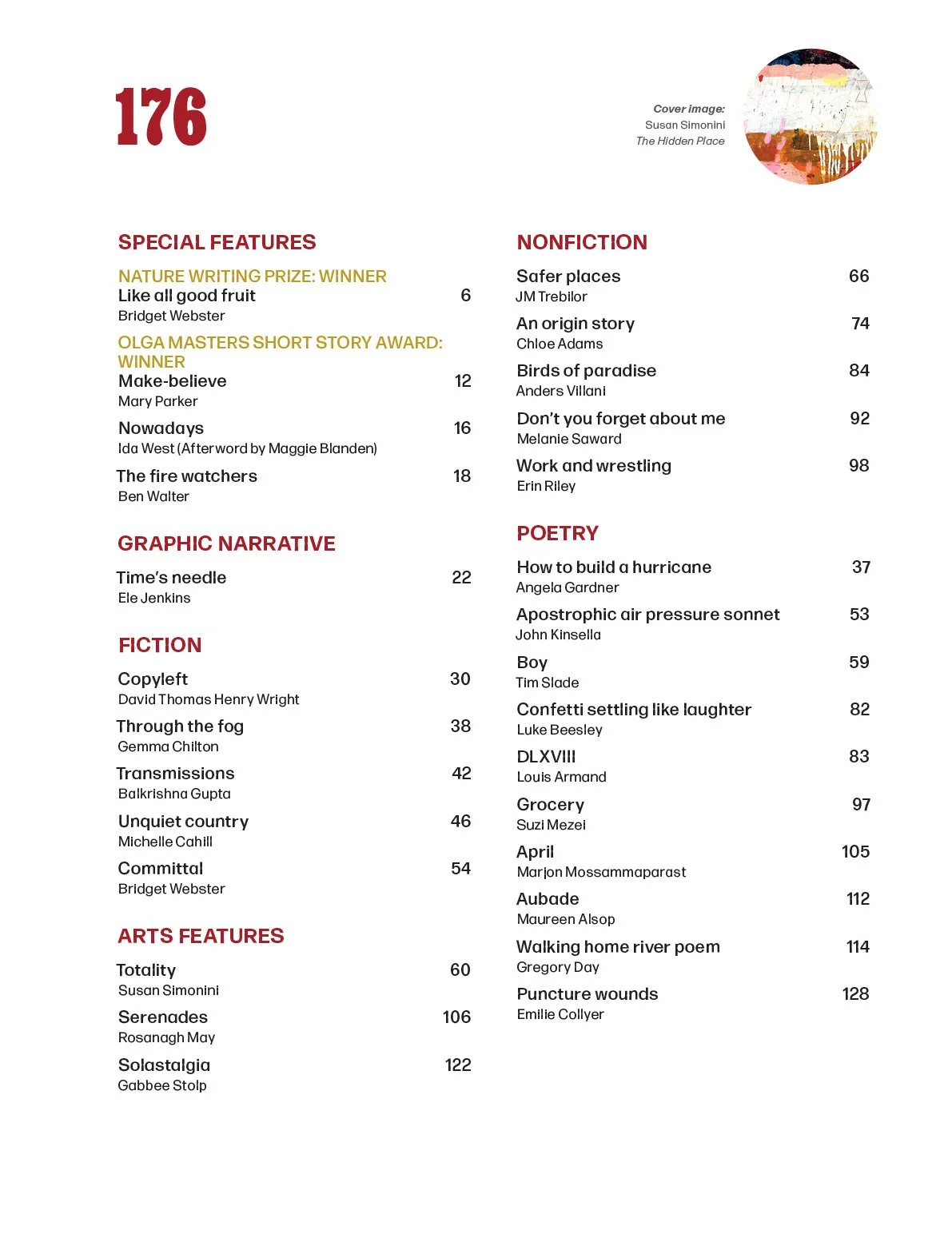 Image 2 of 2
Journals like Island – and like the recently axed but much-needed Meanjin – are a vital part of the literary ecosystem. We provide a place for new writers to develop their talent and to be read, perhaps for the first time beyond a small circle of friends and family. We are an avenue for publication for established writers solidifying their careers. We are a snapshot of the times: of the ideas driving writers to the desk, of the modes of expression taking their fancy, of the influences and preoccupations weaving their work together. And through prizes, we spotlight and reward some of the country’s best writing. This issue, we’re delighted to publish the winning piece from our very first Nature Writing Prize, run in conjunction with the Tasmanian Land Conservancy and Fullers Bookshop. We received more than 180 entries, and the 3 judges were unequivocal in giving the prize to ‘Like all good fruit’ by Bridget Webster. Because we read the pieces without any names attached, it wasn’t until much later that we realised Bridget shows up twice in this issue: her brilliant short story ‘Committal’ was selected by Fiction Editor Kate Kruimink. What a pleasure to showcase the work of such an exciting new writer! This issue also includes Mary Parker’s wry ‘Make-believe’, which won the Olga Masters Short Story Award, a prize for fiction about rural life.
I’m also really pleased to publish two pieces of important Tasmanian writing: an excerpt from Ida West’s soon-to-be-reprinted Pride Against Prejudice, the first autobiography by a Palawa person; and Ben Walter’s reimagining of legendary bushwalker Jack Thwaites’ notebooks, based on research he conducted during his 2025 State Library and Archives of Tasmania Writing Fellowship.
— Jane Rawson, Editorial Manager
This issue’s poems skate along the dimensions of perception. They allow direct address (Kinsella: ‘O pied stilt’), recorded sensation (Collyer: ‘Busted is how my foot feels’), discovery (Alsop: ‘I found/ desire’) and the larger ‘reconstruction of reality’ (Gardner). This carefully observed perception allows these poets to arrive at moments of epiphany; take Slade’s recognition of the moment of ‘boyhood ending’ or Mezei’s piercing statement that ‘we are all so hungry’.
I love that poetry and perception can move from the direct to the oblique and both can bring equal joy. Mossammaparast subverts TS Eliot’s ‘cruelest month’ into her opening ‘April/ is the month of the cruelest dogs’, moving the reader sideways. Beesley takes the reader into his unique sensibility: his sidesteps reveal unimagined connections – resemblances, puns, absurdities, the very ‘mischief of wakefulness’. Armand’s alliterative, allusive ‘DLXVIII’ sets a rhythm in its first line that carries the reader into a rich, particular music.
Cataloguing is one of the most enduring ways of marking perception. Gregory Day’s long ‘Walking home river poem’ is an exemplar of the accumulative power of the catalogue: it is not a sightseeing list but rather an act of creation. The biome through which Day moves unfolds for the reader in a rich, generative manner, re-initiating the world.
— Kate Middleton, Poetry Editor
The fiction in this issue seems a sustained exploration of the theme of being beset, of the vulnerable being targeted by outside forces. It’s easy to imagine why these ideas are on writers’ minds, and the presence, wit, balance and urgency of their voices reform and reimagine them in surprising ways. In Alex Goodfellow’s ‘A quiet day’, a domestic worker looks after surfaces while, underneath, crisis develops. In Gabrielle Lis’s ‘I was once my mother’s darling’, a deity grapples with meaning in a changing world, while in ‘Jayvon’, James Bradley slowly subverts a coming-of-age story. Questions of futility and giving up are weighed in Hei Gou’s ‘The ascent’ and, in ‘The spring cycle’ by Cloe Anlezark, intruders conspire about a child’s intricate world.
— Kate Kruimink, Fiction Editor
It comes as no surprise that nonfiction and self-examination tend to go hand in hand, that the nonfiction essay often starts with a very personal question that needs answering. The essays in this issue each demonstrate that looking outward for answers usually leads to an inward turn. In ‘An origin story’, Chloe Adams traces her history to Hiroshima and the post-war Allied occupation of Japan in a stunning essay of personal and familial discovery. Erin Riley turns to one of their wrestling heroes to investigate the emotional and bodily effects of burnout in ‘Work and wrestling’. In the lyric essay ‘Birds of paradise’, Anders Villani confronts a traumatic experience and examines how it has shaped him as a person and a poet. Melanie Saward discovers a disturbing and rarely reported trend behind her grandmother’s dementia in ‘Don’t you forget about me’. And in ‘Safer places’, JM Trebilor exposes the cycles of shame, trauma and violence that trouble the passage from remand to rehabilitation.
— Keely Jobe, Nonfiction Editor
The ways our emotional and physical worlds intersect to enable us to effectively communicate our hopes, loves and losses is at the heart of the work explored in this issue’s art features.
Rosanagh May’s emotive ceramic art celebrates the power of lyrics. By imbuing her ceramic vessels with hand-painted imagery and lyrics she captures those otherwise fleeting words; highlighting them for deeper reflection, elevating them and fusing their intent into a physical tangible form. May’s wildly expressive use of shape and beautifully detailed hand-painted nostalgic imagery elevate the overall synergy of her striking works.
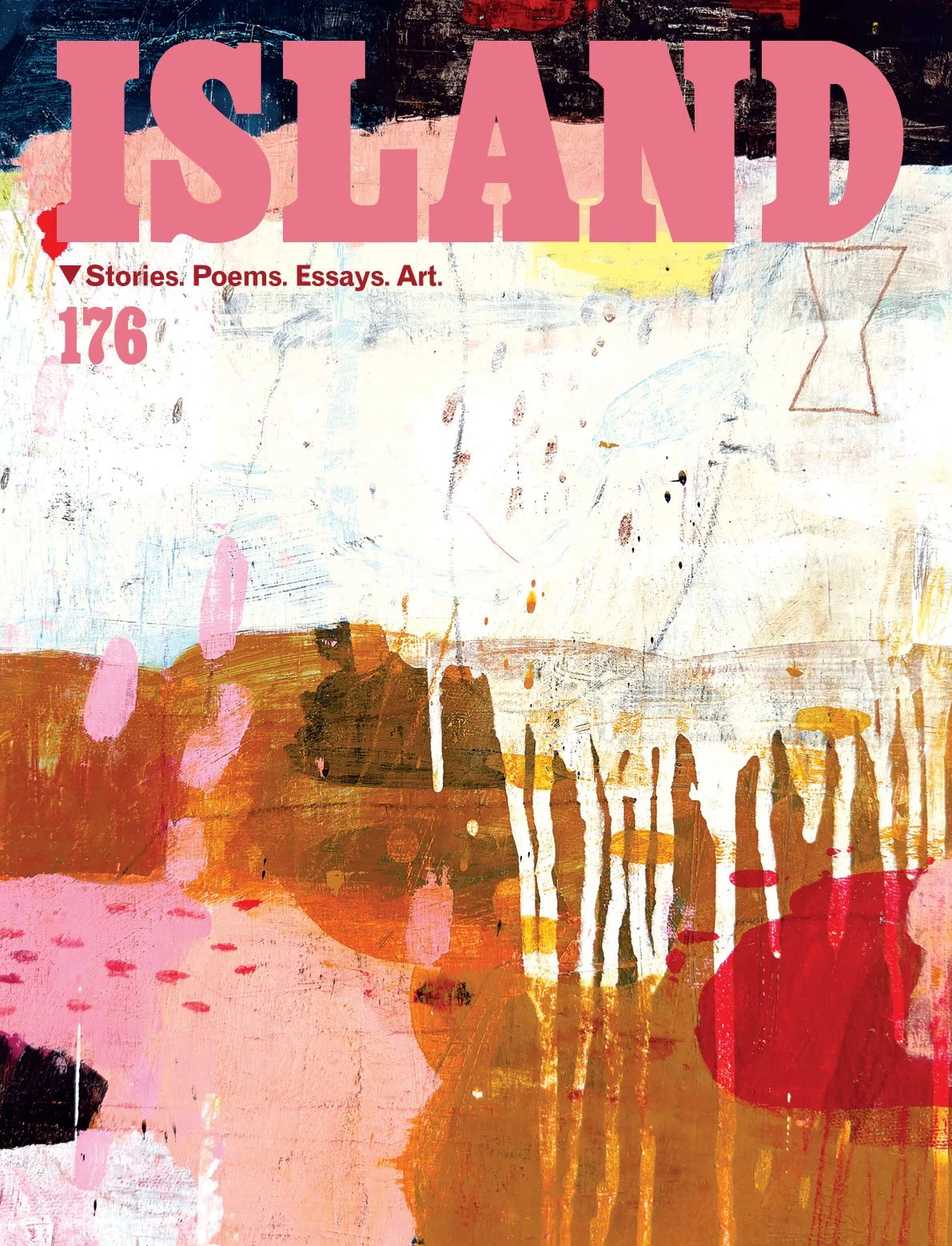
Susan Simonini’s vibrant paintings are abundant with the use of rich colour and freeform mark making. Her works are gritty, joyful and bursting with life. Simonini balances the vibrancy and vitality of her works with a considered use of muted colour and contemplative space, allowing her compositions to find a rich and harmonious resolve.
Gabbee Stolp’s sculptural works and jewellery extend the parameters of adornment through use of natural forms and textures, bold colour and metallic materials. Stolp creates mesmerising sculptural native creatures and jewellery that highlights the perplexing ingenuity of organic form. These works remind us of the wonder and finite nature of all beings coexisting with and despite us. Stolp’s captivating works energise pathways of connection and cohesion between us and the greater seen and unseen world.
— Tamzen Brewster, Arts Features Editor
I am feeling particularly smug for having chosen Ele Jenkins’ pitch for Island’s graphic narratives project. The pitch for ‘Time’s needle’ was vague and unformed, but I had a sense that Ele was pushing comics in a new direction. Across the year, we held development conversations about the piece as Ele plumbed the depths of what she was trying to achieve. I began to suspect that we might be watching them do something truly interesting in bringing together comics, thread and needlework.
Navigating the emotions involved with caring for an intimate partner is not something I have seen often represented in literature. Being a carer myself, I often struggle to put words to this experience. ‘Time’s needle’ articulates in its visuals knowledge that I have felt in my bones for years, but not in language, weaving form and content in a way I have never seen before.
A fully realised piece like this belies how deeply experimental the creation process was. I am frankly excited for what ‘Time’s needle’ means for comics and I cannot emphasise enough how singular this work is, nor how proud I am of Ele’s accomplishment.
— Joshua Santospirito, Graphic Narratives Editor