
 Image 1 of 2
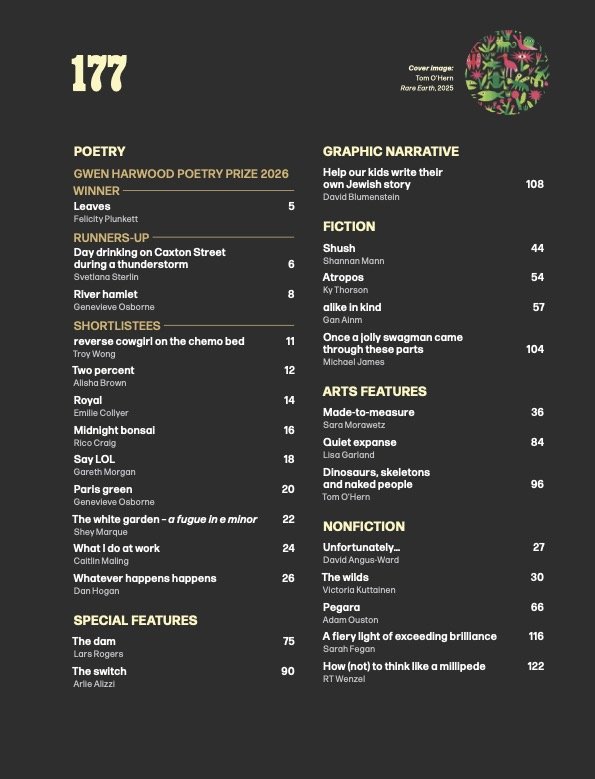 Image 2 of 2
This issue we are delighted to welcome Neika Lehman, who is piloting a new position for Island, First Nations Editor. Neika will be working with First Nations writers around the country to help bring their stories to the magazine’s pages, starting with a deeply personal reflection on Pat Califia’s 1980s lesbian erotica classic Macho sluts, penned by Yugambeh writer Arlie Alizzi. This issue also features ‘The dam’, a debut essay from the winner of the 2024 Margaret Scott Tasmanian Young Writer’s Fellowship, Lars Rogers (keen Island readers will remember Lars’ fantastic story from issue 173, ‘An oral history of piracy’). And of course we are so proud to once more present the Gwen Harwood Poetry Prize, supported by Hobart Bookstore. It’s always fascinating to see the shortlisted poets’ names revealed after the judges have been through the lengthy ‘blind’ selection process. This is Poetry Editor Kate Middleton's final issue and we will greatly miss her sensitivity, ambition and dedication to Australian poetry. Enjoy another issue of great and often confronting reading as established superstars and emerging voices grapple with the mess of a situation we find ourselves in.
— Jane Rawson, Editorial Manager
It was never a question that I would start this guest editorial series for Island with Arlie Alizzi, a Yugumbeh writer and editor who has galvanized my thinking since we first crossed paths as postgraduate students in Australian Indigenous Studies at the University of Melbourne in 2015. This is because, and I believe true again in this contribution, Arlie’s writing evidences a cosmopolitanism in shared Indigenous values (here I am thinking of the teachings of place and ethical relationality), which lives and breathes brightly and almost entirely unbothered by Australia’s obsession with an a-historical white nationhood. While reflecting on this first commission, I remembered the fabulous quote by Waanyi genius Alexis Wright, in Sydney Review of Books: ‘I believe cosmopolitan ideas are a very strong feature in the Aboriginal world through our willingness to reach out to the world of other people, and in particular, the spiritual world of other people, to find ways of accommodating them into the spirit of place in this country’. And now that her sentence is there, I’m sure Wright’s words will track through the next three commissions to come.
— Neika Lehman, First Nations Editor
This year’s Gwen Harwood Poetry Prize was judged by incoming Island poetry editor Tim Loveday, Tasmanian poet and scholar Graeme Miles and myself, Kate Middleton. We each read the entire collection of poems entered for the prize: as in previous years, this process was ‘blind’. From individual longlists we compiled a combined longlist of 33 poems that, through lengthy discussion, we whittled to the shortlist of 12 that appears in this issue. From there, with additional discussion, we ultimately selected our winner and two runners-up. I would like to thank my fellow judges for a thoughtful and enriching discussion process that was always generous and direct. Each time we returned to the shortlist, we tested the poems against our everyday lives, examining how each one had moved with us through the world. We hope that these are poems that will return to readers’ minds as they have returned to ours.
The 2025-2026 Gwen Harwood Poetry Prize has been awarded to the poem ‘Leaves’ by Felicity Plunkett. This is a poem that dwells in the urgency of the immediate moment, drawing the reader into emergency. From the opening phrase ‘Every night/is an ending’ the poem breaks into the heart-heavy thud of reality: ‘late-night text’, ‘ambulance, tachy-/cardia, blood’, rewriting the rhythm of life to the context of sudden necessity. In the midst of the present tense, the world itself becomes active – ‘Rain shoves leaves/ into drains’ – and the hospital setting remakes familiar language, revealing once more the underlying vulnerability of the human in a waiting room that has ‘Standing/ room for walking wounds’. The illusion of human toughness fades in this poem that unveils the fragility of the body – ‘sternum, ankle, wrist,/ chest’ – as well as the tenderness and terror of recognising the ways we are so often powerless to protect those we love. ‘Leaves’ is a poem that stood out to the judges from our earliest discussions as working at the highest order. Line break, rhythm and musicality, form, control and subject all work together in a remarkable poem that undeniably matters.
Two runners-up were selected in the judging process, reflecting very different but equally powerful worldly experience. ‘River Hamlet’ by Genevieve Osborne is poem that encompasses the life and underlying dread of a rural village. Taking formal cues from Alice Oswald’s ‘Village’, Osborne injects space, image and repetition into a thrilling kind of contemporary ballad. Eliza May is ‘walking the river path bending in mangroves looking for bones’; these same mangroves and their inhabitants are an active force in the poem. ‘Crabs suck/ and bubble in the mud’, while that mud ends up on shovel, boots and glove. The mangroves, themselves witness, are ‘hunched and still’, constantly looming while refusing further testimony. While the perspective shifts between local characters, hints at suspicion and knowing and the ‘somebody asking why nobody’s asking’ about the ‘beautiful child’, it is the river, the mangroves, the mud and the crabs that envelope the poem, the reader, creating an unforgettable mood.
Svetlana Sterlin’s ‘Day drinking on Caxton Street during a thunderstorm’ offers a kaleidoscopic urban scene in which time and relation become slippery amid a slick cascade of detail. This poem takes place between the definite and the conditional: ‘if I was someone else’, the speaker states, ‘I’d have worn my wedding outfit/ to the Halloween party’. This ‘if’ is just one form of uncertainty, of the unrealised, that haunts the poem, or ‘creeps’ into the speaker’s – and therefore the reader’s – vision. What emerges is a productive uncertainty and ambivalence: ‘I don’t feel any way about it’, the speaker repeats, suggesting not indifference but the inarticulable desire to make meaning of the fragments of living.
The shortlist as a whole represents a rich array of Australian poetry. These poems take us: from ‘necro-data products’ to the embodied realities of the chemo bed; from the longboat to the king hit; from deadly ‘Paris green’ made with arsenic to the eye processing the colour blue; from the historic treatment of autistic children to a life lived moving between ‘swimming at Carlton, reading at a café/across the road’ and home to the ‘veranda breathing wishes into air plants’. These poems move through forms and traditions with ease and ambition.
— Kate Middleton, Poetry Editor — Jane Rawson, Editorial Manager
The four stories in this issue are connected by an urgent theme: seeking to understand your own place in a world gone strange, or a world seen anew. They all explore re-contextualising your identity up against the world. My pull toward this kind of story must be fairly straightforward from a psychological standpoint, given the times we live in. In the skilled and temporally fluid ‘alike in kind’ by Gan Ainm, a young man facing the death of his father learns something of deep significance about himself and his family, while in the complicated, subversive world of ‘Shush’ by Shannan Mann, a young woman is delivered somewhere liminal and required to make consequential decisions. In Ky Thorson’s ‘Atropos’, a serenely confused girl drifts into a very wet, personal kind of apocalypse, while in the witty and assured ‘Once a jolly swagman came through these parts’ by Michael James, a life in Queenstown is rendered at once viscerally familiar and deeply strange.
— Kate Kruimink, Fiction Editor
It’s the beginning of 2026. It seems everyone’s already exhausted and feeling a lot. Thus, the essays selected for this issue are fittingly heart-on-sleeve. Sarah Fegan tackles migraines, religion and the fraught experience of queer friendship in their delirious and uplifting essay, ‘A fiery light of exceeding brilliance’. In ‘The wilds: what grief narratives have taught me’, Victoria Kuttainen uncovers how academic reading failed her during a time of grief, and the overlooked genre that offered healing instead. RT Wenzel is inundated by many-footed insects who complicate the author’s ethical approach to living with and in nature. Their hilarious, frenetic essay ‘How (not) to think like a millipede’ is a must for avid gardeners and nature-lovers. In his stream-of-consciousness essay ‘Unfortunately …’, David Angus-Ward bemoans the life of an unpublished writer – and in doing so gets published. And finally, in his wide-ranging and emotionally charged piece ‘Pegara’, Adam Ouston puts Tasmanian government infrastructure projects under the microscope, revealing a questionable record of expenditure and business dealings marked by hubris, ineptitude and a persisting colonial mindset. With the recent approval of the Macquarie Point Stadium, this piece could not be more timely.
— Keely Jobe, Nonfiction Editor
Art is as much the process and methodology of creating as it is a finished artwork. Lisa Garland is an artist who embodies the creative process, from the slow and deeply considered act of taking her large-format images, to the hours spent late into the night developing prints in an almost meditative state. She is fully engaged throughout each stage of the development of her photographic works, which themselves are truly immersive. Sara Morawetz’s practice interrogates the intricate methods developed to make sense of our world through acts of measurement. Her works reframe our perspectives on what we consider a basis, a norm developed to give us certainty while inadvertently eliminating broader scope and possibility. Morawetz asks us to look again, consider and really reconfigure our concepts of reality. Tom O’Hern is his art/his art is him; I don’t know if or where there is any degree of separation or process. This is what makes everything he makes such a force and a reprieve from all the shittiness. There’s really no need to say any more: his work speaks for itself, go have a look!
— Tamzen Brewster, Arts Features Editor
Editing comics for a quarterly magazine means nonfiction works can’t be too closely tied to the relentless news cycle. An eight-page comic also takes time to create, which adds to this problem. Comics, being hand-drawn, have a remarkable capacity for being underestimated and can quite easily bypass our defences, so I have quietly been holding out in hope of receiving a pitch that finds a way to speak to broader world events. I have been reading comics by David Blumenstein for years now. He loves exploring awkward uncomfortable truths, and is an observational storyteller who stares directly into the nuances of cultural phenomena such as pick-up-artists, NFTs and the uptake of AI. In his piece for Island, ‘Help our kids write their own Jewish story’, he draws scribbly lines of connection between after-school programs in suburban Melbourne and a genocide being waged on the other side of the world. I adore the rich subtext in all of David’s work and this brightly pencil-coloured narrative about narratives has plenty of subtext.
— Joshua Santospirito, Graphic Narratives Editor