
 Image 1 of 2
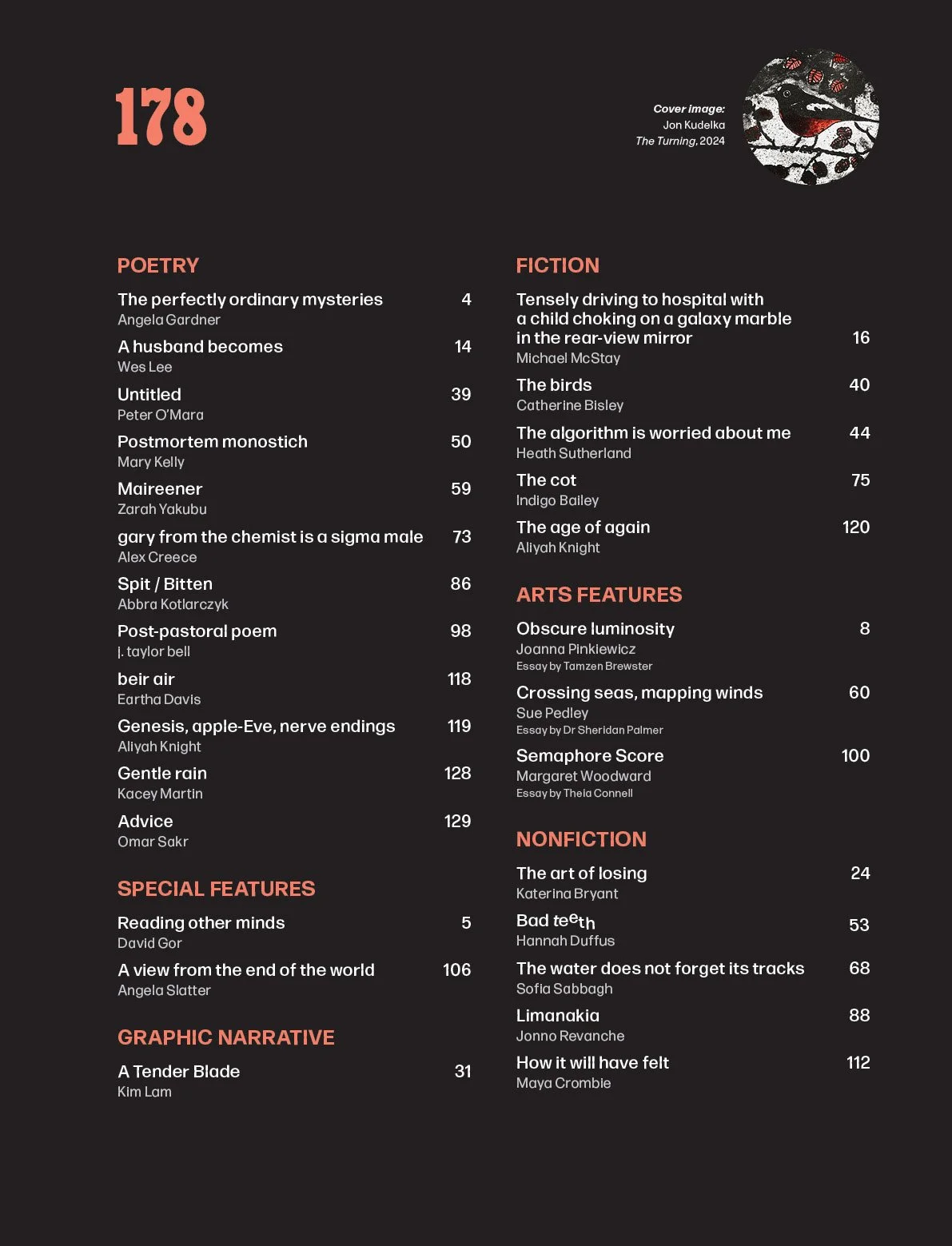 Image 2 of 2
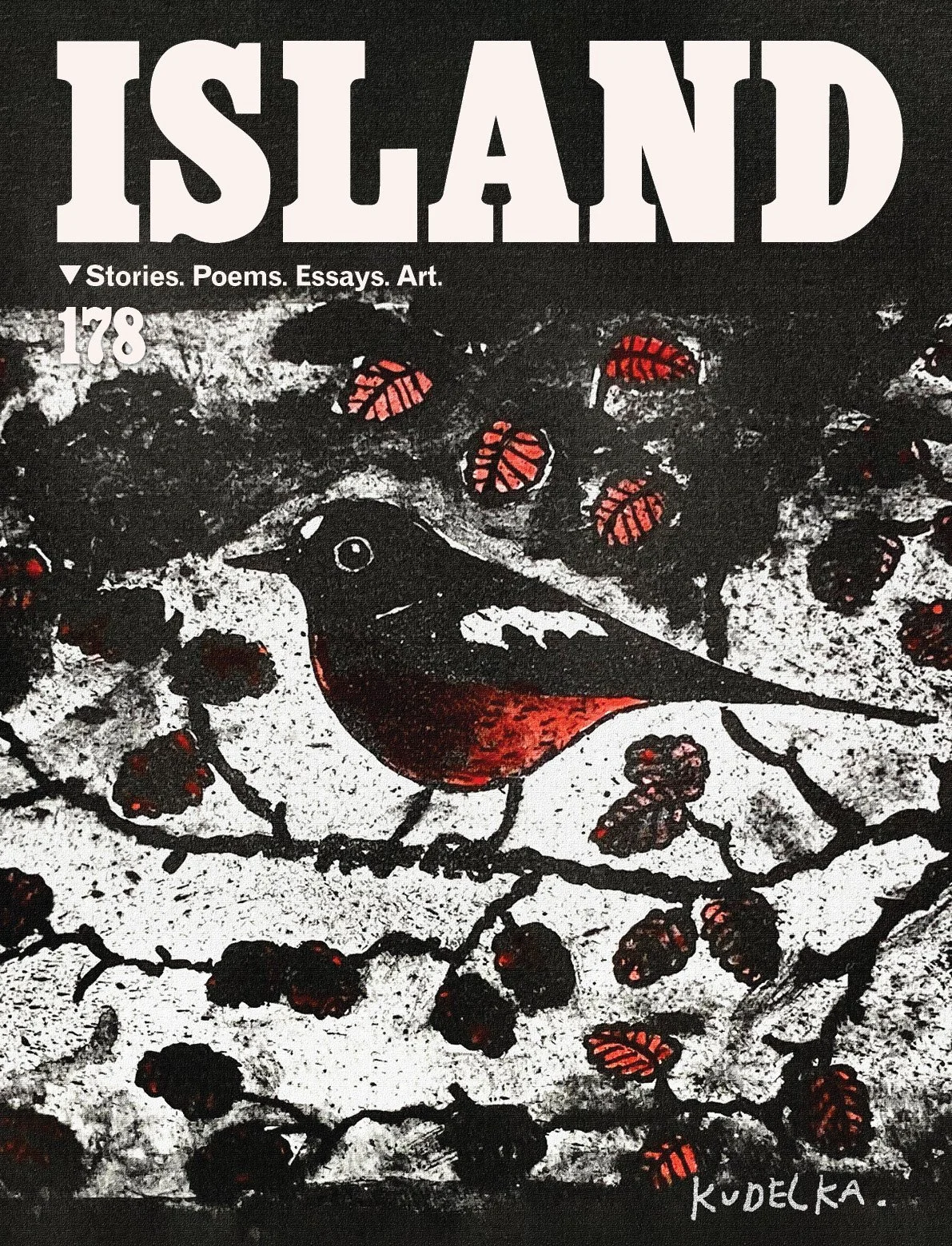
This issue of Island arrives from the printer as the first-ever Island Readers & Writers Festival kicks off. Among the many events is a session called ‘Comics Live’, during which comic artist Kay Kudelka will present the work of their late father, the legendary Jon Kudelka. Jon’s family have very kindly allowed us to use his beautiful work ‘The turning’ on this issue’s cover, an image of a scarlet robin emerging from a branch of Nothofagus gunnii. Jon wrote, ‘If you visit Tarn Shelf at Mount Field National Park around Anzac Day, you’ll see the leaves turning yellow and gold and bright red. If you’re lucky enough to pick a clear day and you hang around until evening when the light fades, the red leaves seem to burn more brightly than they should and you might catch a fleeting moment of inexpressible beauty in the cold still air that you can carry in your heart forever’.
Maybe the festival will include some beautiful, fleeting moments; we hope it will create a space to think things through, to imagine, to challenge, to delight, to feel. As David Gor so eloquently puts it in his essay in this issue, when we take the time to consider another person’s writing, ‘something shifts. What felt alien begins to make sense from the inside. An argument you dismissed as trivial suddenly reveals its stakes. A worldview you thought was bizarre turns out to have been a rational response to its environment’. Stop, read, listen, think, breathe.
— Jane Rawson, Editorial Manager
‘I was blessed with the catastrophe of words,’ writes Kevin Brophy in his lyric essay ‘Why I am a poet’, a work that asks just that: what is it that makes one a poet? Last night while doomscrolling I came across an interview with Louise Glück. In it, she hoped that the title of poet might only be bestowed after death, so sacred it is apparently. Feeling inadequate, I checked the comment section: Eileen Myles had written something akin to ‘shove off’.
I hope the poems in this edition teach you not what poetry is (or who gets to be a poet) but what poetry can be: ‘a catastrophe of words’. Enter Alex Creece’s sardonic, associative poem, ‘gary from the chemist is a sigma male’ (he ‘hits a snag | at bunnings | performs kayfabe like a ham-n-egger’). Or j. taylor bell’s ‘Post-pastoral poem’, a piece deluxe with spatial & poetic disintegrations (‘pausing the setting sun on the lip / of a fressko cup’). Or Abbra Kotlarczyk’s caustic and surreal ‘Spit / Bitten’ – a masterclass in disruption, the frayed of image through atomisation, a signalling toward the precarity of the state (‘Squared revolving cube shifting / Hands fumbling for unity on a bus that is late.’). The poems in issue 178 teach us that there are many ways to write a poem (and just as many to be a poet) – but each of them, likely, involves an assemblage of (or anchorage to) catastrophe.
— Tim Loveday, Poetry Editor— Jane Rawson, Editorial Manager
The fiction in 178 is concerned, among other things (many other things!), with the body in peril, the body surveilled, and the body in anti-peril: the body born anew. In Aliyah Knight’s ‘The age of again’, a woman dissolves into body parts again and again. She’s not only more than the sum of her parts, but more than her parts themselves. In ‘Tensely driving to hospital with a child choking on a galaxy marble in the rear-view mirror’, Michael McStay explores love and boundaries: the boundaries of the body, and the boundaries of convention between two people. Catherine Bisley reflects on eco-ethics and grief through an unexpectedly positioned narrator, while Heath Sutherland examines the interaction of human and algorithm. In ‘The cot’, Indigo Bailey draws a rich world of surveillance, need and authenticity. As a collection, these stories riff and converse and create something – is this too neat? – that is also more than the sum of its parts.
— Kate Kruimink, Fiction Editor
178 is a bumper nonfiction section, combining first-time nonfiction writers and seasoned essayists. In ‘Bad teeth’, Hannah Duffus gets braces at 30 and looks at the function of teeth in popular culture, holding a mirror to beauty standards and class politics with a sharp eye and a tender story of family. Comics artist Sofia Sabbagh makes her nonfiction debut with ‘The water does not forget its tracks’, a meandering tale that takes us from the Lismore floods to the fight for water sovereignty in Palestine. In ‘How it will have felt’, young writer Maya Crombie riffs on experimental music forms, reflecting on the tangled relationship between sound and memory. In ‘Limanakia’, the inimitable Jonno Revanche offers a sprawling tale of Greece's gay beaches with delectable prose and hilarious asides, in a mode of enquiry that evades any kind of squareness. I first encountered Katerina Bryant's work in Hysteria, an incisive book exploring seizure disorders, mental health and medical sexism. In ‘The art of losing’, she meditates on the writing life alongside the hypercompetitive world of chess. What stayed with me in ‘The art of losing’ is the writer’s prerogative to hold onto the intrinsic pleasure of art and strategy over external reward systems; navigating the challenges of life in the stepping stones of small moments, movements that allow us to overcome loss.
— Zowie Douglas-Kinghorn, Guest Nonfiction Editor
The arts features within include stories of connection, communication, human-nature and escape. Two of the features examine historical events relating to Lutruwita/Tasmania’s convict past where the artist’s reimagining of these stories brings enthralling new dimension and meaning.
Margaret Woodward is the first artist to receive the Creative Fellowship at the State Library and Archives of Tasmania. Semaphore Score is the result of her examination and extension of the 1868 Tasman Peninsula – Semaphore Code Dictionary, a colonial dictionary used to deliver messages between Port Arthur and Nipaluna/Hobart. Woodward’s new codes express emotion and identity, giving voice and validation to the human experience that echoes so loudly around the historical records.
Sue Pedley’s Prevailing Gales responds to a mutiny by 18 convicts who successfully seized control of the brig Cyprus at Laylatiya/Recherche Bay in 1830 and, astonishingly, sailed to Japan. Pedley’s works carry the essence of oceanic conditions through linework, composition and rich texture, connecting the viewer to the physicality of the sea and this incredible story of a wild grasp at freedom.
Joanna Pinkiewicz’s featured work is a different exploration of human-nature and connection. Her vibrant works are resolved through multifaceted processes that are informed by her understanding of oneness and the broad network of interconnected natural systems. Her works hum with a quality of synchronised harmony.
—Tamzen Brewster, Arts Features Editor
Kim Lam is present at the beginning and end of many lives. A veterinarian must be skilful, gentle, present, as they deal with bodies (and perhaps souls). When she sent through her final pages for ‘The Tender Blade’ I printed them off, made coffee, leaned into my studio armchair and fell into the pages, seeing the soft colour schemes of this dreamscape for the first time. At my most articulate all I can say is ‘some comics are a total vibe’. I must have gazed at these eight pages for half an hour before realising I was late for work.
Amid the Taoist concepts of rebirth there are layered artistic references that make my brain glow: Doré, Dante, Blake, Miyazaki, of course, but also multimodal contemporary artists like Aidan Koch, Cory Feder, even Australia's own Leonie Brialey. This piece belongs in a lineage of artworks that refine meaning out of life through the act of drawing the unseen soul, by wielding a compassionate knife.
— Joshua Santospirito, Graphic Narratives Editor