
 Image 1 of 2
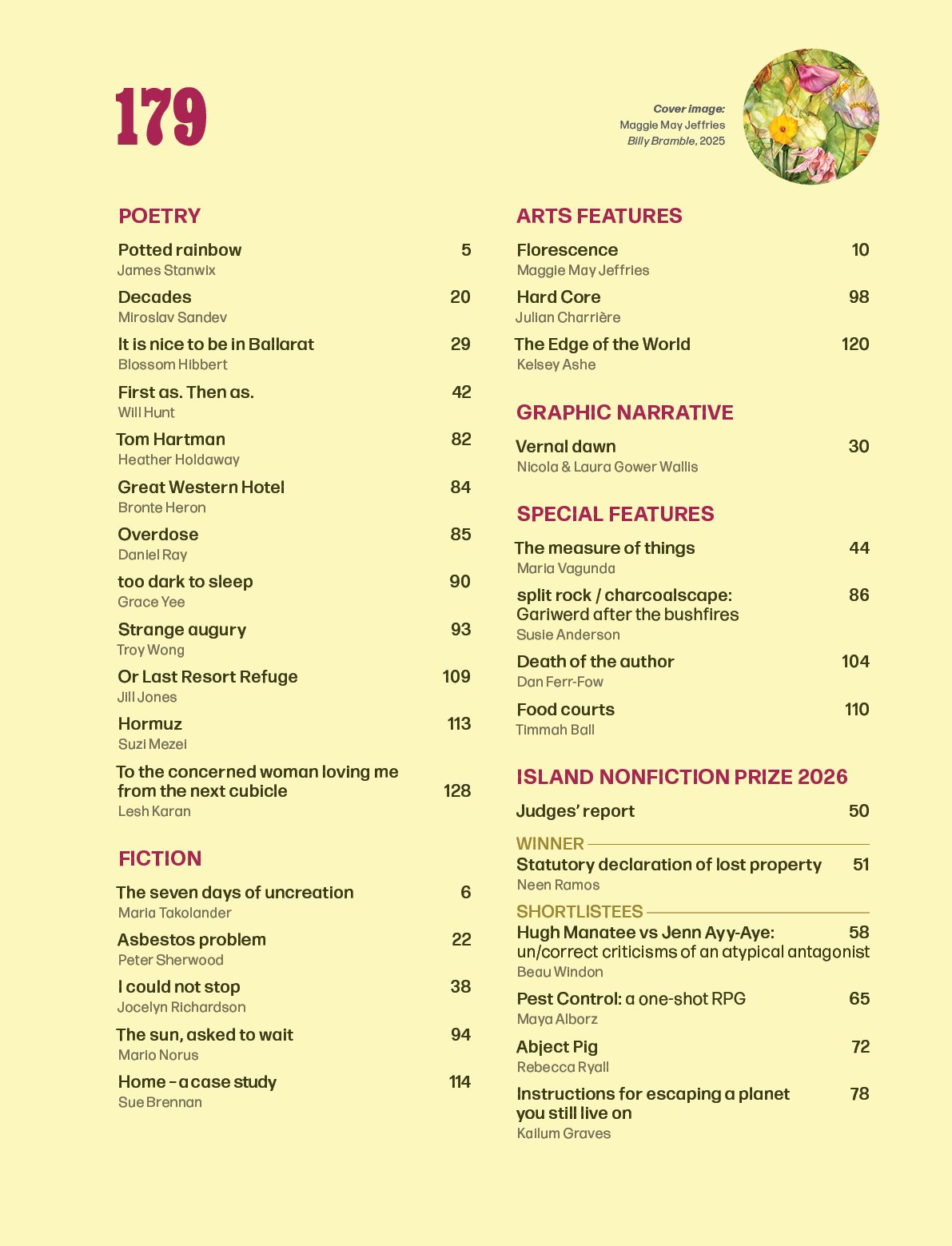 Image 2 of 2
Welcome back, Island Nonfiction Prize! After a year in hiatus, we are pleased to once again feature some of the best new nonfiction writing being produced by Australian writers. Over my past three years as editor, I’ve noticed an increasingly inward focus among nonfiction writers – a concern with the body, the identity, the peculiar personal pains of being alive in the 2020s – and we certainly saw that in submissions for the prize this year. Through experiments with form and genre, this year’s shortlisted writers let us witness and understand their experiences in profound ways. I’m grateful for the thoughtfulness and imagination each of them deployed in writing these pieces.
The inward focus is not surprising. The things happening in the broader world are so huge and so difficult (Miroslav Sandev isn’t wrong when he writes, ‘it’s clear to me this won’t ever slow down’) and we’re all more conscious of the ethical boundaries around subjects we shouldn’t cover. But there is also the sheer cost and effort of writing a complex piece of researched nonfiction. How can a writer justify the months and dollars spent on investigating, checking and perfecting a piece that involves other places and other people’s lives, knowing how few outlets there are in Australia for essays, and how small the compensation will be if they do find a publisher? It’s time to tax the billionaires and bring on a universal basic income: give writers the time and money they need to write.
— Jane Rawson, Editorial Manager
On the way to manja cave (cave of hands), bush fire ash coats Susie’s own manja. They smudge grey across the poet’s face like grief-stained ochre: the image of accidental ceremony in this strange old and new world. The uneasy meaning in tending to ancestral Gariwerd connections during global climate chaos charges through Susie Anderson’s essay. Writing between Rome, Narrm and at home on the family farm, she pens this grief humbly and head on, representing a specific and multilayered expertise of experience that many Kooris will recognise. One meaning to stay with settler readers, I hope, can be found in the example of certain Australian rock-climbing culture. With charm and humour, Susie encourages First Nations allies to consider where their support for Aboriginal sovereignty might be surprisingly conditional.
—Neika Lehman, First Nations Editor
‘The end is not here yet – but it’s coming,’ said American poet Joseph Millar during a generative writing workshop I attended in Forest Grove, Oregon. Millar was responding to someone who’d asked what time the class finished. It was a poetry bait-and-switch; rather than addressing the question head on, he’d gone global, philosophical, political. He’d told the truth, but slant. In his response, I read an argument for a sly wit, a way of being in the present moment – a time of ever accelerating polycrisis – that captures our capacity for agency (psychically, materially, manifestly) while refusing to negate what we’re facing. The end is not here yet – but it’s coming.
Enter the poems in this edition. In ‘Decades’ Miroslav Sandev weaponises a sardonic and slippery syntax, the claustrophobia of public transport transmogrifying into a diatribe against a civilisation hellbent on hurtling toward endpoint: ‘Days are sawn-off and pressed up / against each other like commuters / on the flash new metro’. In Will Hunt’s couplet-driven ‘First as. Then as.’, a father’s conspiratorial musings trigger a memory: ‘we / wrote a letter to Julia Gillard, all of us / asking her to save the whales, to stop / a different kind of boat.’ While in Grace Yee’s narrative eulogy ‘too dark to sleep’ the poet performs witness, retrospectively recounting an entire life. All of these poems, despite their complex subject matter, make an argument beyond grief, beyond an acceptance of the inevitable. These are poems of now – poems of quiet (and sometimes loud) living, a cunning humour rubbing up against an end that is not quite here yet.
— Tim Loveday, Poetry Editor
This issue we’re thrilled to be publishing the shortlisted essays from this year’s nonfiction prize. I was grateful to be joined by our guest judges, Hayley Singer and Sam Elkin. Deciding on a shortlist from such a large pool of talent isn’t a one-person job, and when aiming for a range of diverse writing, we need a diversity of expertise and perspectives to find the right mix. Hayley Singer says of our selected pieces, ‘The shortlisted works are alive, serious, deeply poetic, sometimes hilarious, politically vital and uncompromising in their creative experimentations’. And Sam Elkin has this to say: ‘With so many worthy contenders, the selection process was exceptionally tough. The shortlisted works offer an electric, wide‑ranging vision of Australia full of wit, courage and experimentation’.
I would like to congratulate every writer who submitted a piece to this year’s prize. Taking the time to put your ideas, feelings and politics into words feels more noteworthy by the day, and it was such a buoying experience to read what’s important to each of you, to see you make tricky connections, to see the unique ways you each shape your stories. Writing is tough. It should be. It should feel like an act of resistance. So, keep writing, keep resisting.
Congratulations in particular to our shortlisted authors. You blew our socks off. In ‘Pest Control: a one-shot RPG’, Maya Alborz demonstrates how experimentation in form can offer not only thematic resonances but emotional apertures too. Told from the perspective of a young Iranian woman, the gaming format gives a taste of the discrimination and degradation experienced by immigrants in Australia today. This is a stifling work to read but peppered with glorious moments of fury and fortitude. In ‘Abject Pig’, Rebecca Ryall begrudgingly forms a relationship with her neighbour’s porcine pet and finds herself confronted by the violent ubiquity of commercial meat industries. Ryall goes to the uncomfortable places we habitually turn away from when we sit down to eat, and she does so with courage, empathy and exceptional research. Sometimes you read an essay with your heart in your throat. This is one of those essays. Beau Windon has written a piece for the times with ‘Hugh Manatee vs Jenn Ayy-Aye: un/correct criticisms of an atypical antagonist’. In this hilarious and scatty essay, which is marked by playful errors and rhythmic hiccups, Windon brandishes neurodiversity and his Wiradyuri heritage as weapons against AI, making a case for the flawed, the incorrect, the nonsensical, in short, the human. You may find yourself fist-pumping while reading this piece. Kailum Graves highlights the life-saving role of books in ‘Instructions for escaping a planet you still live on’. Describing the everyday effects of complex post-traumatic stress disorder, Graves explains how first reading and then writing science-fiction helped him navigate, or indeed escape, the private worlds that threatened. Writing about trauma is a very particular skill. It is not easily done in a way that invites the reader in but Graves succeeds in spades. Our winner for this year’s nonfiction prize is Neen Ramos with her startling, experimental essay, ‘Statutory declaration of lost property’. This essay takes the form of a common legal document to describe the Filipino diasporic experience, an identity position that crosses borders, spans seas and grapples with loss every day. The limitations of the legal document are resounding, and it’s delightful to see the writer test its boundaries at every turn. As this prize is judged blind, there was no way for us to know that Ramos is an emerging writer, or that she was writing in her second language. This is a very Australian story. We’re thrilled to publish it as the winning piece.
— Keely Jobe, Nonfiction Editor
This issue’s arts features all have particularly nuanced approaches to observing and communicating concepts ranging from deep time and wildness to the details of capturing light at midnight. Maggie May Jeffries’ fascinating paintings are alive with botanical form and convey an alluring sense of narrative. Their many layers all exude movement and rhythm. Jeffries deftly uses her impressive understanding and ability to convey qualities of light to create scenes that mirror back to us the complexities and simplicity of all that is ‘natural’.
Kelsey Ashe’s prints are absorbing, emotive and rich in detail. You can feel a wildness that permeates her work, tipping over into otherworldliness with the use of phosphorescent inks, extending the works into glowing nocturnal scenes. Living with these works must be wondrous, inviting you to quietly observe through the night. Swiss–French artist Julian Charrière kindly answered some questions about his epic solo show Hard Core. Commissioned by Mona in Nipaluna, Hard Core is a deeply considered immersive experience and an invitation for recalibration.
—Tamzen Brewster, Arts Features Editor
Comics have been printed in Island magazine for long enough now that I’ve noticed that they’re beginning to have a conversation among themselves. Leonie Brialey’s work in cowboy esoterica (Island 167) is speaking sweet-nothings to Kim Lam’s dreamscape of death (178). ‘Time’s Needle’ (176) was complexified by a wild injection of Ele Jenkins’ thread-work, not a gimmick but form determined by content, which makes me contemplate its connections with this issue’s gouache-painted gem ‘Vernal dawn’, by Tasmanian artist/writer sisterly duo of Nicola and Laura Gower Wallis.
I’ve always been deeply drawn to works where masters of other mediums weave their knowledge into visual storytelling practices: in this case Laura’s words (wildly fun to read aloud to your children, elderly neighbour and lovers) are not just ‘brought alive’ by Nicola’s gouache but by the extraordinary handling of movement and colour. ‘Vernal dawn’ is a comic about the shifting seasons, changing light, and our place in nature for an issue published in the moods of the September equinox.
— Joshua Santospirito, Graphic Narratives Editor