
 Image 1 of 2
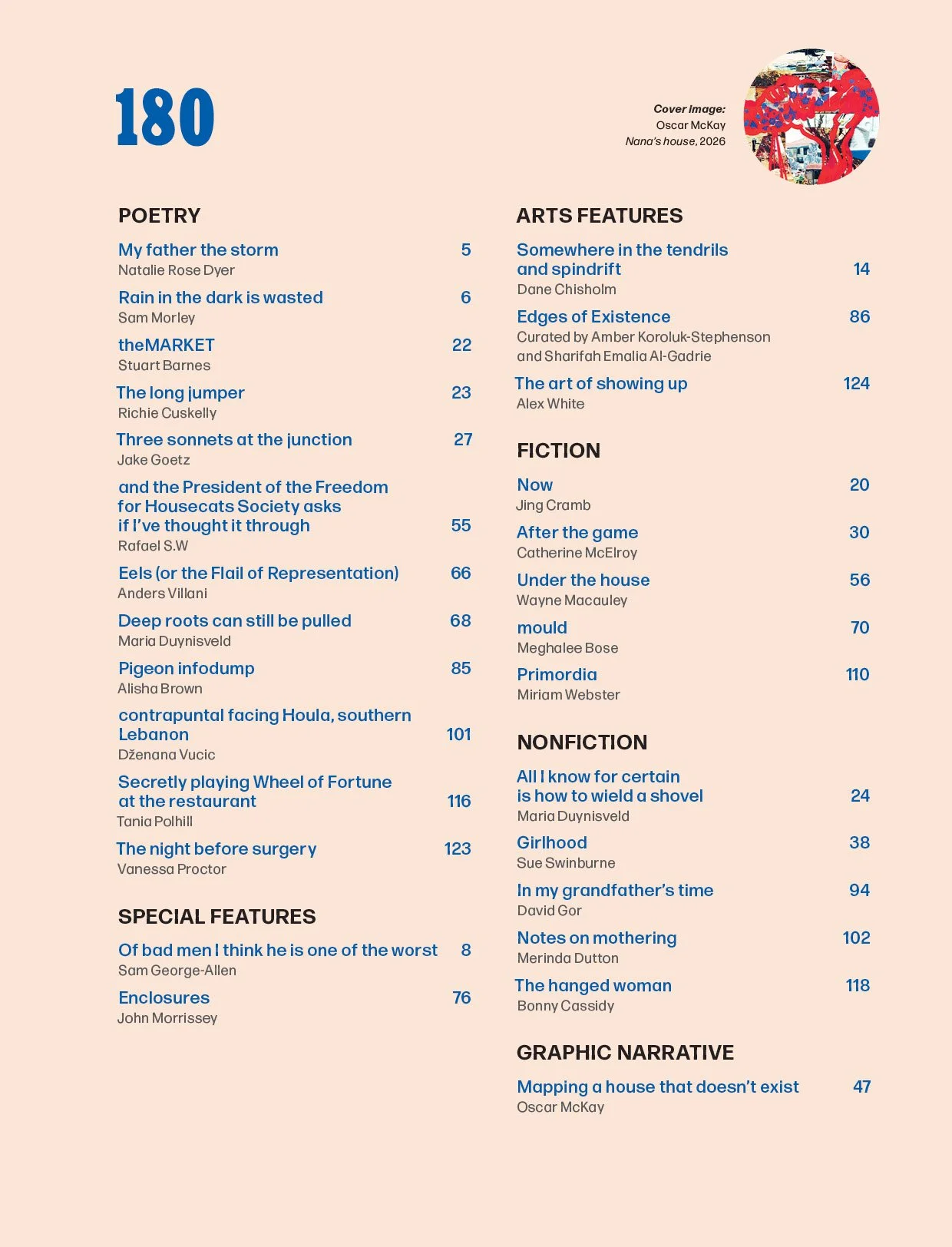 Image 2 of 2
This is my twelfth, and last, issue of Island. What a treat it’s been to curate this significant outcropping of Australian literary heritage. My inclination is to list all my favourite pieces from the past three-plus years, but I know I’d leave out loads and possibly upset someone and what if my selection wasn’t balanced and I… they are: ‘Please wake up’ by Valerie Ng, ‘Dogs’ by incoming Island editor Jennifer Kremmer, ‘Death of a landscape artist’ by Talleyn Burch, ‘In the valley’ by Caitlin Maling, ‘The perfect human’ by Niki Bañados, ‘Airtight’ by Andrew Roff, ‘Lateral ambling gait’ by Emilie Collyer, ‘Namesake’ by Indigo Bailey, ‘A choir of shore’ by Gregory Day, ‘What we become’ by Rosie Murrell, ‘YES!’ by Raymond Arnold, Leigh Rigozzi and Tony Thorne, ‘A story-shaped life’ by Gan Ainm, ‘The breath goes now’ by Jessica White, ‘Writing task 1’ by Suri Matondkar, ‘Any other substance’ by Daniel Ray, ‘Stories in paintings and letters’ by Paul Collis and friends, ‘Gilgamesh’s oracle’ by Zaina Fraillon, ‘Milk teeth’ by Gurmeet Kaur, ‘My Kaathi Sister’ by Julie Janson, ‘Gunk’ by Alex Creece, ‘The last two years’ by Rodrigo Lopez, ‘Mouse men’ by Tyson Yunkaporta, ‘An oral history of piracy’ by Lars Rogers, ‘the good, the bad, the elderly’ by Tim Loveday, ‘Art exchange’ by Nadia Refaei, ‘Jayvon’ by James Bradley, ‘A quiet day’ by Alex Goodfellow, ‘Like all good fruit’ by Bridget Webster, ‘Time’s needle’ by Ele Jenkins, ‘Safer places’ by JM Trebilor, ‘reverse cowgirl on the chemo bed’ by Troy Wong, ‘Royal’ by Emilie Collyer, ‘Say LOL’ by Gareth Morgan, ‘Dinosaurs, skeletons and naked people’ by Tom O’Hern, ‘How (not) to think like a millipede by RT Wenzel, ‘Advice’ by Omar Sakr, ‘Reading other minds’ by David Gor, ‘Decades’ by Miroslav Sandev, ‘The sun, asked to wait’ by Mario Norus, ‘mould’ by Meghalee Bose, ‘All I know for certain is how to wield a shovel’ by Maria Duynisveld, ‘Of bad men…’ by Sam George-Allen and, from my brief stint as Fiction Editor, my favourite story of all time: ‘The end of the dream’ by Hei Gou. (Honourable mentions from Island Online are ‘1.’ by Bobby K, ‘Grass, willow, skin’ by Ben Walter and ‘Prelude to a flight’ by Joel Keith.) People say ‘privilege’ too much and I’d like to join in: it has been a real privilege to bring these pieces to your eyes. Thank you to every specialist editor I have worked with, because they’re the ones who have brought these pieces to my eyes – they do incredible work sifting through piles of submissions and making very painful choices about what to publish and what to let go, and they are brilliant at working with creators to sensitively make their work the very best it can be. Thank you to proofreader Sabine Borgis, who every single issue teaches me something new about how language works. Thank you to the Island board for being supportive and thoughtful. Thank you to the two Business Managers I have worked alongside, Adelaide Reisz and Beth Duncan, who actually make all of this happen. Thank you to Futago and particularly designer Broden Polley, who started making this magazine at about the same time I did, and who has become very, very good at it – most people who read Island do so because it’s beautiful, and it’s beautiful because of the work that Brodie and the Arts Features Editors (Jude, Tamzen) do. And thank you to whichever public servant came up with the bright idea that taxpayers’ money should go towards supporting literary magazines: you rule! Welcome to brand new Island Editorial Manager Jennifer Kremmer: I can’t wait to see what you do.
- Jane Rawson, Editorial Manager
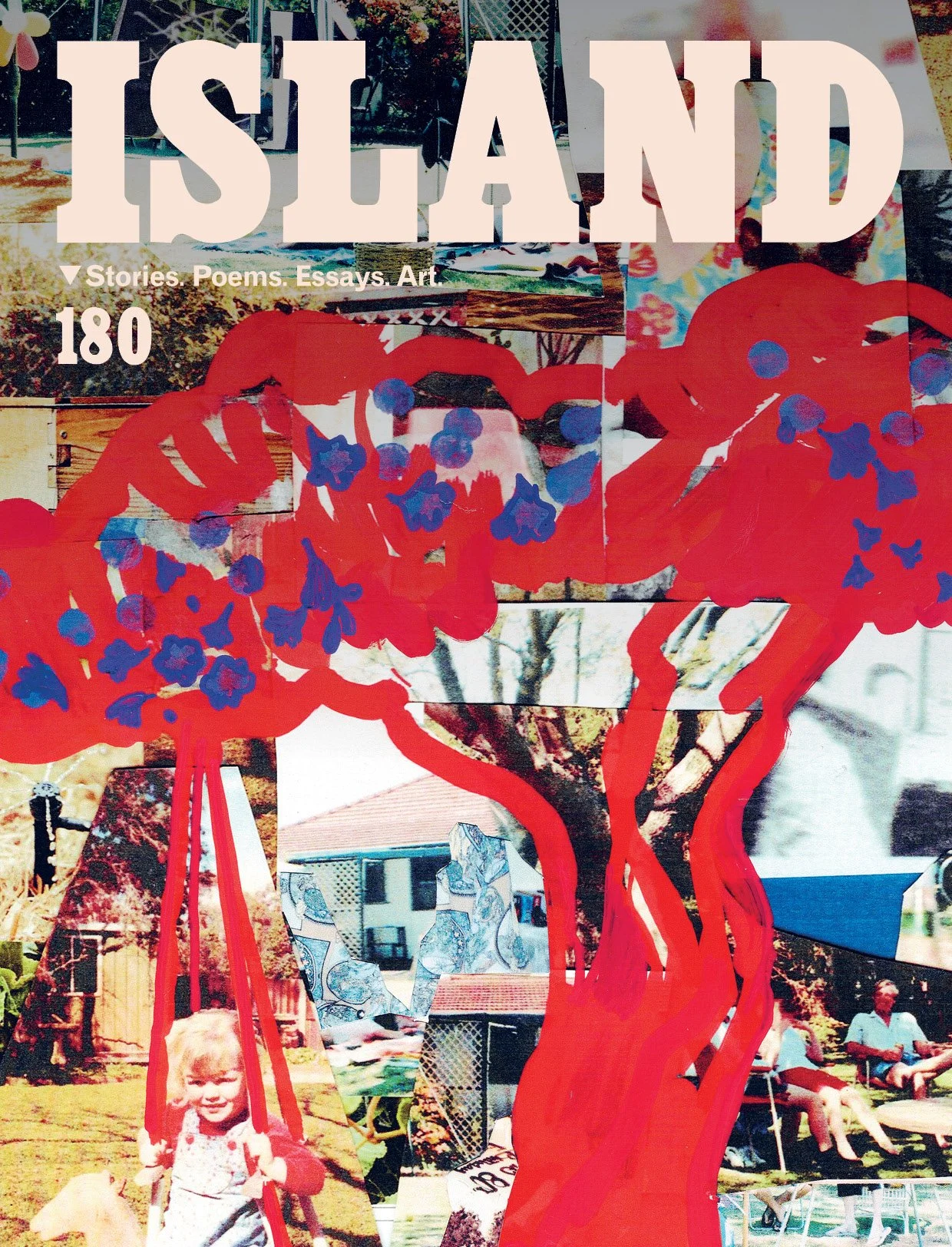
Architecture houses our suburban experience. Stories embedded in structures feel like a hyperlink to the different country that is the past. Oscar McKay’s comic ‘Mapping a house that doesn’t exist’ finds ways to triangulate the deleted stories through examining shared memories. It is a collage made of translucent paper (the use of which is oddly emotional), rough sketches, and scraps of real estate magazines, giving us clues as to how we process nostalgia and grief.
- Joshua Santospirito, Graphic Narratives Editor
This is my last issue at Island, and I’m feeling very grateful to have been trusted with this role for the last three years. I’ve worked with a diverse group of writers in that time and they taught me that, more than clear prose or perfect grammar, a writer wants agency over their own work, which is their voice. A writer’s voice is their ace in the hole – it’s the one thing they’ve got that no other writer has. I’m so pleased that Island continues to offer a space for that creative autonomy. This issue, our authors leave it all on the page. Merinda Dutton turns to her ancestors when broaching motherhood. David Gore demonstrates the slipperiness of cultural memory within the colonial context. Maria Duynisveld gives us a glimpse into farming life and her own thoughts on stewardship. Sue Swinburne revisits a formative relationship and examines what it means to believe in the impossible. And Bonny Cassidy considers her experience of gender in a changing body.
- Keely Jobe, Nonfiction Editor
The hundreds of stories submitted for this issue were of the highest quality. These five I’ve chosen, by Meghalee Bose, Jing Cramb, Wayne Macauley, Catherine McElroy and Miriam Webster, represent a profoundly skilful literary precision. There is a plumber wedged under a house and an otherworldly birth. There are women dancing and a creeping infestation. There are young girls together in an unyielding culture. You couldn’t find a more human bunch if you tried.
- Kate Kruimink, Fiction Editor
Recently, I drove past Launceston’s City Park, glimpsing the iconic Japanese Macaque enclosure. In 2024, the local council voted in favour of the monkeys’ mass sterilisation. Their calculated demise left me melancholic. Ironically, this is the same feeling I get after visiting any zoo. In today’s screen-based reality, is the zoo becoming an antiquated spectacle? Imperial hangover or not, nothing compares with the zoo’s wrestling layers of otherness. This is precisely the mood of John Morrissey’s new short story ‘Enclosures’. A quiet master of everyday jamais vu, ‘Enclosures’ demonstrates why John was named a SMH Best Young Novelist in 2024.
- Neika Lehman, First Nations Editor
This issue’s arts features explore action and resolution through the methodology of making. Alex White’s highly textured black-and-white prints of shelters and wilderness scenes capture the essence of being within the landscape of Lutruwita/Tasmania. Dane Chisholm’s works immerse you in the rhythm of coastal networks and celebrate all the wonder found between land and sea, particularly all the wonderful birds! We gain insight from Amber Koroluk-Stephenson and Sharifah Emalia Al-Gadrie, the curators of Edges of Existence, which was a powerful and complex exhibition of artists working in textiles. Lastly, a huge thanks to Jane for being such a force and supporting all of Island’s specialist editors so thoroughly!
- Tamzen Brewster, Arts Features Editor
‘When I write poetry, I’m the Prime Minister of poetry – I get to do what I want.’ So said poet Ender Başkan, the recently elected Prime Minister of poetry, having just won the Prime Minister’s Literary Award. No truer words! Both through form, and in total rejection of it, these poets legislate new ways of seeing, and undoing, the world: biblical encounters in late-night queer clubs, mythology-infused observations of weather-faring fathers and bird-heavy analogies mapping unsettled co-dependencies, not to mention the rarified labour perils of long jump. Every one of the poets featured in this edition do whatever they want, and with Prime Ministerial (anti-)authority.
- Tim Loveday, Poetry Editor