
Life Span – by Fiona Reilly
ISLAND | ONLINE ONLY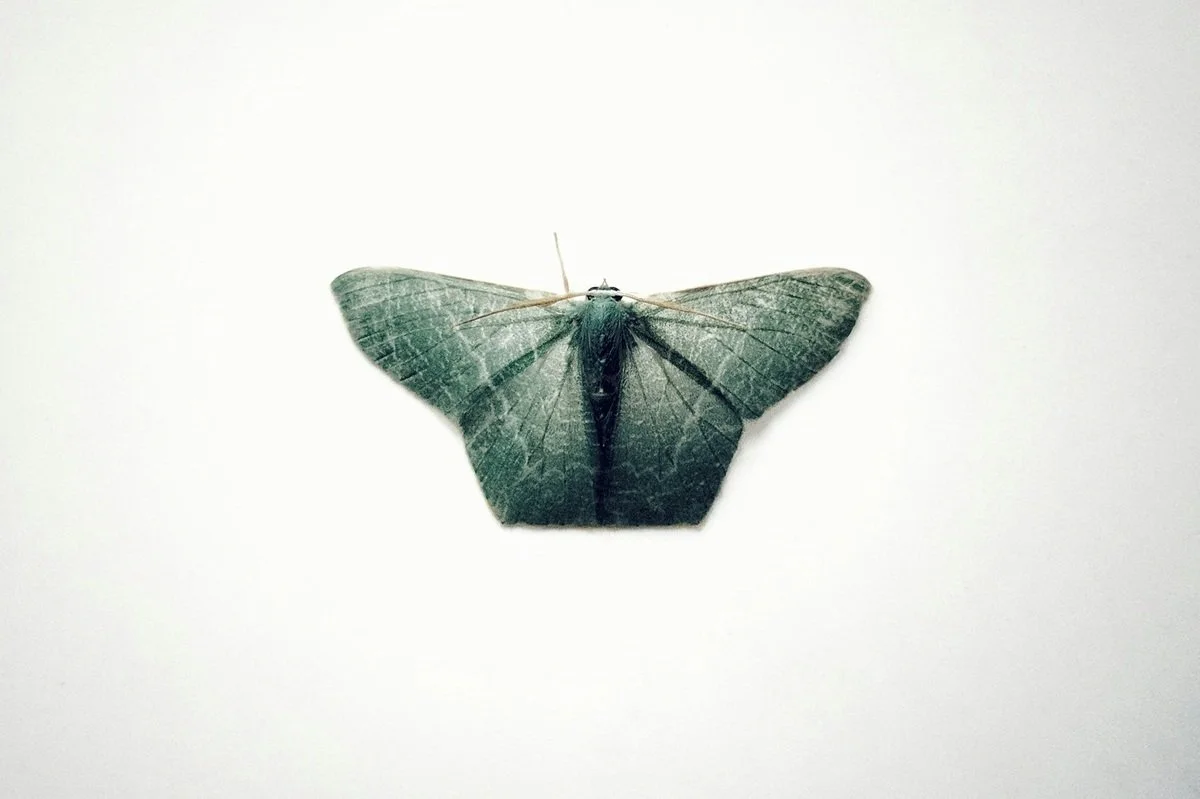
Every night, broad wings of black, brown and silver fluttered against my windows, drawn by the kitchen lights. Hundreds of moths scattered across the glass, forming a dark floral pattern against the inky backdrop of the night sky. If I forgot to close my windows they rushed indoors, the tiniest ones creeping through the brass collars of the ceiling lamps before lying down in the curved milky glass to die. The larger moths flew back and forth in desperate laps, and each morning my floor was littered with their velvet bodies; their wings gently pressed together in rigor mortis. It distressed me, but by then I was distressed about so many things. I sighed, sucking them up efficiently into the clear plastic barrel of the stick vacuum.
One morning a tremendous moth lay on its back in the middle of the kitchen, wings stifflyfolded, legs drawn up across its chest. I cradled its soft sable body in my hand hoping it would flutter, but it lay quite still. It was too magnificent to be sucked up like the others. As I watched, the slender brown feather of one antenna unfurled ever so slightly, and its leg moved. It was alive. I opened the kitchen window, high above the grass below, and released it, hoping that the sensation of air, of falling, of speed, would cause it to rally a profound will to live and spread its wings before it hit the ground below. Did its wings lift the moth away? Was it swooped into a magpie’s beak on the way down? I couldn’t bear to look. On my palm, the moth had left behind pearlescent chocolate wing dust. Without knowing why, I brought my palm to my lips and kissed.
There seemed no explanation for the moths, no mention in my suburb’s Facebook group. Wasn’t everyone else disposing of hundreds of moth corpses each morning? Was the outbreak confined only to my home? Online I discovered scientists called this moth snow, a phenomenon of moth clouds so thick it was like driving at night through a snow flurry. It didn’t happen often anymore apparently, and insect grille counts on cars were down by 56%. I tried and failed to imagine the kind of dedicated person such studies required.
++
Not long before the moths arrived, my father left. A retired Scottish engineer, he dealt with the news of his cancer by running away to Tasmania. He’d already packed his rusting four-wheel drive with camping equipment and enough dry food for six weeks. He was making his final checklists when he showed me his scan report for the first time. Multiple spots, scattered through both lungs.
‘How long have you known about this?’ I asked.
He remained silent as I checked the date on the page. Seven weeks earlier. ‘Dad, you’re going to need a lung biopsy.’ As a doctor I understood the exact meaning of the scan; I suspected he did too. The cancer from three years before was back and had spread. But right at that moment I was trying hard to be a daughter, not a doctor.
‘I know,’ he replied, manoeuvring a portable solar panel into the car alongside his tent and sleeping bag. ‘I already have an appointment for it.’
‘You do?’ I asked. ‘When?’
Dad glanced at his watch. ‘About half an hour ago.’
I must have looked confused. A lot of things were passing through my brain at that point, not the least of which was time is of the essence. ‘Half an hour ago?’
He nodded. ‘I cancelled it.’
‘You cancelled it?’ I couldn’t seem to make sense of anything except to repeat the last phrase of everything he told me.
‘It didn’t fit with my travel plans.’
Dad’s travel plans had been in place for some time. He knew exactly what he was doing when he cancelled his lung biopsy and set off camping and hiking in the Tasmanian wilderness. I told him he should stay, have the biopsy and see an oncologist first, and then go camping, if that was what he wanted.
‘You would say that,’ he said. ‘You’re a doctor.’
His thinking made some sense to him. Delaying his lung biopsy would mean prolonging the time in which he technically didn’t have metastatic cancer. The longer he delayed, the longer he was cancer-free. Except he wasn’t.
‘Those cells are multiplying non-stop,’ I said. ‘They won’t stop mutating just because you’re on holiday.’
‘I’ll call you once I’ve crossed Bass Strait,’ Dad said, and hung up.
++
While I waited for him to return, I filled my time with complicated online searches. Not about cancer: I already knew too much about that. About the moths. I might feel less heavy if I could discover why the moths kept coming. Eventually, a plausible answer emerged. Some moth pupae could enter a kind of suspended animation if environmental conditions were unfavourable. They nestled between eucalyptus leaves burrowed deep into the soil, emerging only after soaking rain. Pupae could wait like this for up to five years, I read; twenty seasons of sun and darkness and warmth and cold. Lots of Australian mammals were capable of it too – wallabies, possums and kangaroos – pausing pregnancies for weeks or maybe months. What if humans could do the same? Could we, at the first sign of trouble or bad news, enter a long hibernating pause, until it was all over and we could emerge, blinking and unfurling, into the light?
++
Dad popped up every three or four days from the wilderness to report that he’d seen a potoroo, or a lyrebird. He sounded happy.
‘Made an appointment for the oncologist yet?’ I asked.
‘When I’m back next month.’
‘The oncologist is away most of March,’ I reminded him.
‘April would be okay.’
‘No, it wouldn’t…’ I started, but the line crackled and went dead.
He called for a longer chat after a walk along the banks of Kanamaluka, the Tamar River. The shores were thick with paperbarks and the nests of black swans and swamp hens. The water was a deep dark blue, like the tiny mussel shells cracked open by the birds. The cool February morning had settled into a solid warmth through the middle of the day, he said, the grey clearing for enough hours to throw sharp shadows on the sandy path. I imagined the landscape from the air – the looping river shoreline dotted with birds, the tracts of paperbark forest, and the tufted grasslands giving way to hills. Far beyond them all was Turapina, the mountain. Somewhere in this aerial image Dad was a dot too, moving on foot or by road from wild place to place.
I thought too about my long-ago days as a medical student, and the sense of wonder at how a tissue biopsy looked under a microscope, an aerial view of a beautiful miniature landscape of its own. There were the curves of purple-blue veins, crenelated bronchioles like islands, and the open pattern of the lung tissue. Then on the edge of the microscope’s field, the menacing whorls of cancer cells, like a dark forest.
It was the beauty and terror of nature, I thought. Our cells had the ability to form a perfect, feathered antenna, or a whole magnificent human. They had the miraculous ability to programme a pause in reproduction at times of drought or disaster, and the ability to programme cancer. To understand nature at any level was to be in awe of it, all of it.
As much as I wished to, I couldn’t change my dad’s mind. I couldn’t change the course of the endlessly multiplying cell colonies through his body any more than I could save the moths beating themselves to death against my windows every night. What of the giant moth? Had its will to live been strong enough to fly? I wanted my dad’s will to live to take the shape I thought it should – of chemotherapy in exchange for more life. But that was my need, to not lose him any sooner than I could bear. Perhaps his need was to live, even for a shorter time, immersed in the uncommon majesty of nature. I was simply his witness, accompanying him for as long as it took. I brought my lips once more to my palm, kissing it gently. I let him go like I’d let the moth go, hoping his wings would open before he hit the ground.
▼
Image: Matze Bob - Unsplash
If you liked this piece, please share it. And please consider donating or subscribing so that we can keep supporting writers and artists.