
Melopeia – mellifluous Melos and the madness of melons – by Michael (MRS K)
ISLAND | ONLINE ONLY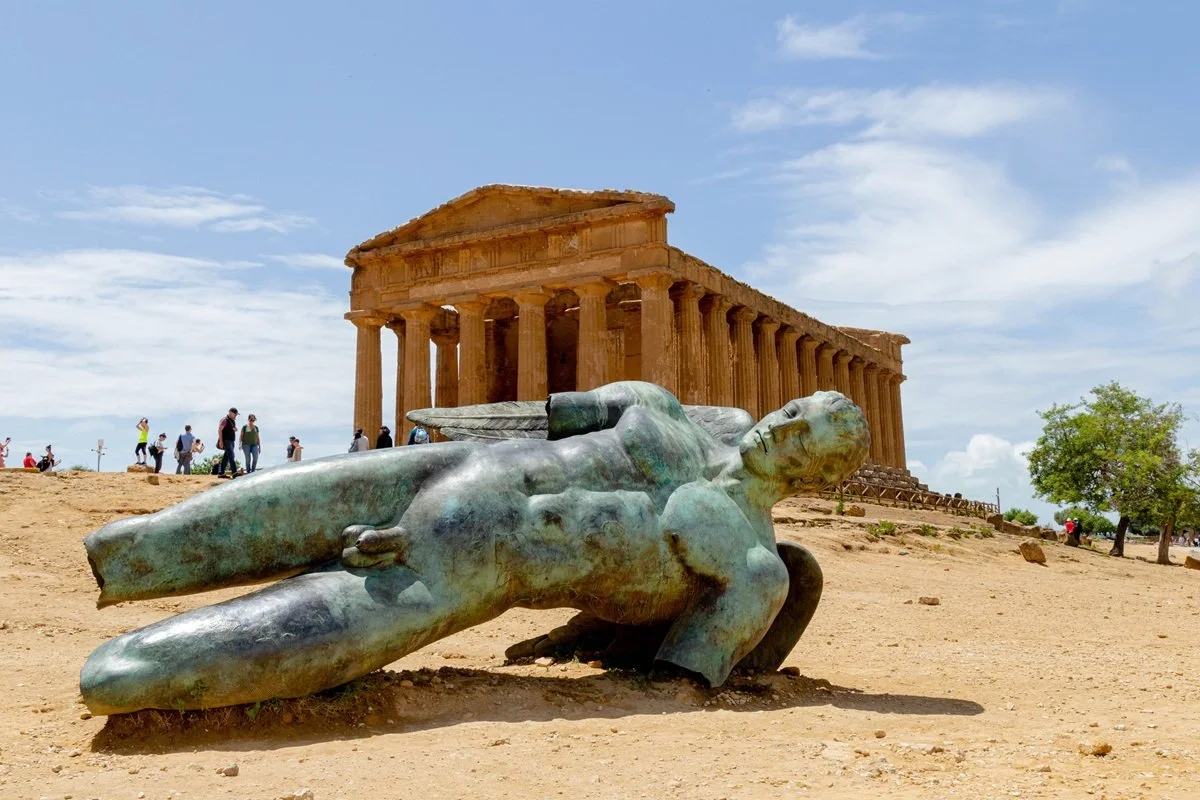
denn du diss, was du isst – German proverb
Melos was a king in eros // many years ago; he was
told by a true companion - i
will give you this do-
main and all its glory. and he rei-
gned – a crapulous, re-
constituted byron, of mostly mi-
lquetoast views, who brewed his fame
in surrounding provinces, and all around the globe, fö-
menting hellenistic poetics, and public int’rest politics, and held
his contemporaries (the scholarly romantics) within
a distillate contempt. he was,
a lover of both ti-
nctures and solfège, and
by all accounts, a
sol-
la-
ss fa-
cking ass; a lord of rust-red skin and rhinophyma, who
hurled juniper’s bolts down on his foes, collected
tithes to slouch behind his throne, in
squalor, flashing poems; daily
rooting, living harum-carum,
good times all the time, sin-
namoning angelica, and Ash-
ually rhymed once Gourdy lyrics // Horny fruit, so making
all the muses blush
to see the sickly stock of Cantaloupée. and yes, this
bibulous bibliophile, this
ruddy versifier so delighted
his subjects with his rages and displays
of Honeyed ororation, his
capricious whims, headless pentameters, end-
less demand for lyres! this gorɠonic liar! this
insuperable king! who, one Dewy morning,
happened on a gin in tyre (en-
tire leda, en-
gravened with some cryptic writing,
upon a satan pillow in a clearance bin!).
and raucously descended to his den – wherein,
upon that turgid ocean
of resplendent stained reGalia, he
did rub upon said djinn – tippling first a little this way,
then a little that. and so he pestered, poked and prodded him,
readying to welcome
some new kiss-arse bootlegger
into his palatial Casaba. but how
the dusty dionysus rose (from out the bottle)! and crawled
towards his laurel on the lino floor, grumbled,
stumblebug cynic that he was, and cried:
you would do well, not reading too- too close into the contents – its …
fvine inscriptions are apocryphal … here lies
absinthe perhaps! or … here’s your absolution! no
sorry … i think that’s aniseed … wait– don’t … hang on …
abaddon that … anacoluthon! well!
wan moon shine shines on you tonight! sure
summer’s gone, а самогон прославиться …
[aside] i think that’s the original greek!
see–
tonight the old boy grants your moneyed wish
from the melon-scum that lines the barrel. you
say you crave Gold Melons … fvine! then let it be decreed
that everything you touch henceforth
will be a Gilty Lemon! your frankensteins,
your missive shits shan’t ever rust!
and all perpetuity shall know
you by your noxious press releases thus!
hardly a second passed this μηλοπέπων,
when Melos felt a stomach-rumbling churn,
as though he’d been downcast into the argo,
as if its prow had chanced on something firm!
and the pink Water rose
higher – ach!
higher! почки на почве! слепота! – WATER
higher higher, vine-must, lynx-fur swirling all about him.
and the sea! and the sea! and a river of expletives
roiling up inside his gullet. he
opened up his politician’s maw
and a river of censorium burst from him
to the sea! to the sea!
so many days and many nights // did Melos rant and rave inside his chambers;
sweating, shaking, howling, blindly raving // blessed by the muses’ formicating touch.
his thyrsty melon crying // agua, please more agua!
then in demotic russian // vodichki, oi
pozhaluysta // eshe kaplyu vodichki!
and the bottles round him spinning // adjutorium nostrum in nomine domini, splashing
splashing all about // and singing, exorcising spirits, singing
singing // water water everywhere …
then
silence.
in memoriam handsome peter bryden malinauskas. ▼
ENDNOTE: When the Library of Alexandria was burnt down around the year 642 CE, the world lost centuries upon centuries of poetry. While some texts were preserved (those that were copied time and time again as a testament to their beauty and aesthetic sensibility), many others were lost. Surely, this text ought to have fallen victim to the ravages of time. It was however, by some unusual set of circumstances, consumed and reconstituted first by Plutarch’s dog, and then by that of Herodotus, and eventually, its pithy scraps found their way into the hands of my great ancestor Caesar Bacillus Cereus, and have since passed through more relatives than I can count. Some of these great men and women devoted their entire lives to compiling the text into one cohesive whole, while others worked on writing commentaries and marginalia. There is even a story of my great great grandfather, a farmer residing somewhere on the outskirts of Kharkov, who with his dying breath, cursed his infant daughter and yelled, well you can bloody have it then! Even from the very early days, it appears that my ancestors had been unsure what to make of the poem. For one, it has always been unclear whether Melos was its author, its editor, its protagonist or someone else entirely. In an earlier version, this Melos finds himself being referred to as Midas midway through the text, whereas Dionysis is periodically referred to as Diogenes. Undoubtedly, much of the fire and brimstone was conferred upon it during the Spanish Inquisition, but who thought of all these melons is anybody’s guess. In the early 20th century, an unimaginable tragedy befell Melopeia – that is, it fell into the hands of a modernist (at the time, we thought him to be a friend of the family) and was rendered borderline unrecognisable. Now, with my health failing and my digestive issues overwhelming my capacity for archival work, I must decide what to do with this poem. Much as it pains me to say this, I am afraid that I cannot trust this work to my Hemingway-obsessed daughter – it has been through too much already. As a safeguard against further corruption, I have sought to publish the text as coherently as possible and with the commentaries presented below. All my adult life, I have been haunted by these melons – now, dear reader, I leave them to you.
Impartial addenda / socially cohesive appendix:
Melon sequence: melon → ash gourd → horned melon → Kalliope → honeydew → galia → casaba → gold melon → [redacted] melon – the melons as they appear through the body of the text / the only capitalised ingredients. None of the ancestors were able to shed much light on what exactly it was about [redacted] melons that caused Melos such consternation.
Ingredients for brewing gin: vodka, aniseed, juniper, lemon, cinnamon, angelica root, carum seed – it is quite ambitious to expect a bootlegger to transform his moonshine into gin, although I suppose that stranger things have happened. These ingredients seem to have been parsed through the opening two stanzas.
Steps for brewing gin: fermenting, brewing, distilling etc. – steps have clearly been missed in the process here and so it is no surprise that Melos has fallen prey to a bad batch of the good stuff. I have almost no doubt in my mind that the umlaut was the work of that modernist hack. It makes not an iota of sense for a poem to contain a word that can be pronounced as either fomenting or fermenting. It is a maddening example of the indecisiveness that plagues this work, and I have included it so that the reader is under no illusions as to the poem’s quality.
German proverb: denn du bist, was du isst (you are what you eat). There is a typographical error in the epigraph, which makes it read as you are what you diss [track].
Melopeia – one of Pound’s three aspects of poetry, alongside phanopeia and logopeia. Melopeia is poetry whose primary quality is its musicality – this poem, like most good doggerel, falls into this class.
Vine-must, lynx-fur – from Ezra Pound’s Canto II which describes the overthrowing of a slave-traders’ ship by the young Dionysis. Again, there appears to be another copy edit here from lynx purr to lynx fur and the reasons for this are to-date unclear.
Gordon – Byron’s middle name, a brand of cheap gin, a play on the apparently gorgon-like appearance of our unfortunate protagonist.
Solfège (do/re/mi/fa/sol/la/ti/do) – the beauty of music; it does not elude me that the replacement of end-rhyme with solfège in the opening stanza sounds onerous and stultifying. I suppose there is some irony in the fact that this melopeia sounds like a dog’s breakfast.
And the devil said to Him, ‘I will give You all this domain and its glory; for it has been handed over to me, and I give it to whomever I wish’ (Luke 4:6) – the Temptation according to Luke.
Rhinophyma – a complication of rosacea, a condition which causes the flushing and pimpling of the cheeks, forehead and nose; it is often exacerbated by excess alcohol consumption. If nothing else, this suggests that the author’s knowledge of dermatological conditions is far superior to their understanding of the mechanics of poetry.
Good times, all the time (from Wet Leg’s ‘Angelica’) – the bacchanal lifestyle of contemporary politicians is well established.
A самогон прославиться – pronounced samagon proslavit’sya, translates roughly to the homebrew will achieve great fame – the author appears mighty pleased to have found that summer’s gone is a homonym for самогон. It is highly doubtful that Dionysis ever did speak Russian in the original, and far more likely that the modernist, having already taken one too many liberties with translation, lost track of the original Greek, and decided that some cyrillic would be better than none.
In Ovid’s Metamorphoses, Midas, a frigid King, happens upon the drunk Silenus (a satire), whom he rescues and entertains for ten days before returning him to Dionysis. Dionysis offers to grant Midas any wish he chooses, and he asks that everything he touches should turn to gold. Although in some versions of the tale, Midas dies of starvation, in Ovid he plunges into a river and that river turns to gold.
μηλοπέπων – pronounced mēlopépōn, the ancient Greek word for melon, appears to have a lovely iambic quality about it.
Почки на почве – pronounced pochki na pochve, literally translating to kidneys on the ground. This appears to be a nonsense. It may well be a reference to kidney failure as one of the sequelae of methanol toxicity.
Cлепота – pronounced slepota, russian word for blindness. This is a well-known complication of methanol toxicity.
Adjutorium nostrum in nomine domini – Latin, used for the exorcising of bad spirits, to be intoned while splashing holy water over heathen.
Water water everywhere – from the dreaded Coleridge (‘Rime of the Ancient Mariner’). It is well known that Lord Byron held Coleridge, along with the remainder of the scholarly romantics, in a deep contempt, and his introduction to ‘Don Juan’ says this in no uncertain terms. He would be turning in his grave to read this poem.
Diagnosis of methanol toxicity: altered conscious state, nausea/vomiting, tachycardia, blindness – the diagnosis of methanol/ethylene glycol toxicity should only ever be made as a clinical diagnosis, with lab results merely a means of supporting the diagnosis and monitoring treatment progress.
Treatment of methanol toxicity: krepkaya vodichka. Before the advent of fomepizole and haemodialysis, the only cure for methanol toxicity was drinking stronger and stronger spirits. The poetic polyglot Melos, in his semi-delirious state, appears to have gotten all muddled up amidst a sea of vodka, vodichka (water), and evil spirits.
Image: Sergio Scandroglio - Pexels
If you liked this piece, please share it. And please consider donating or subscribing so that we can keep supporting writers and artists.