
The aesthetics of endless seeking – by Deniz Yildiz
ISLAND | ONLINE ONLY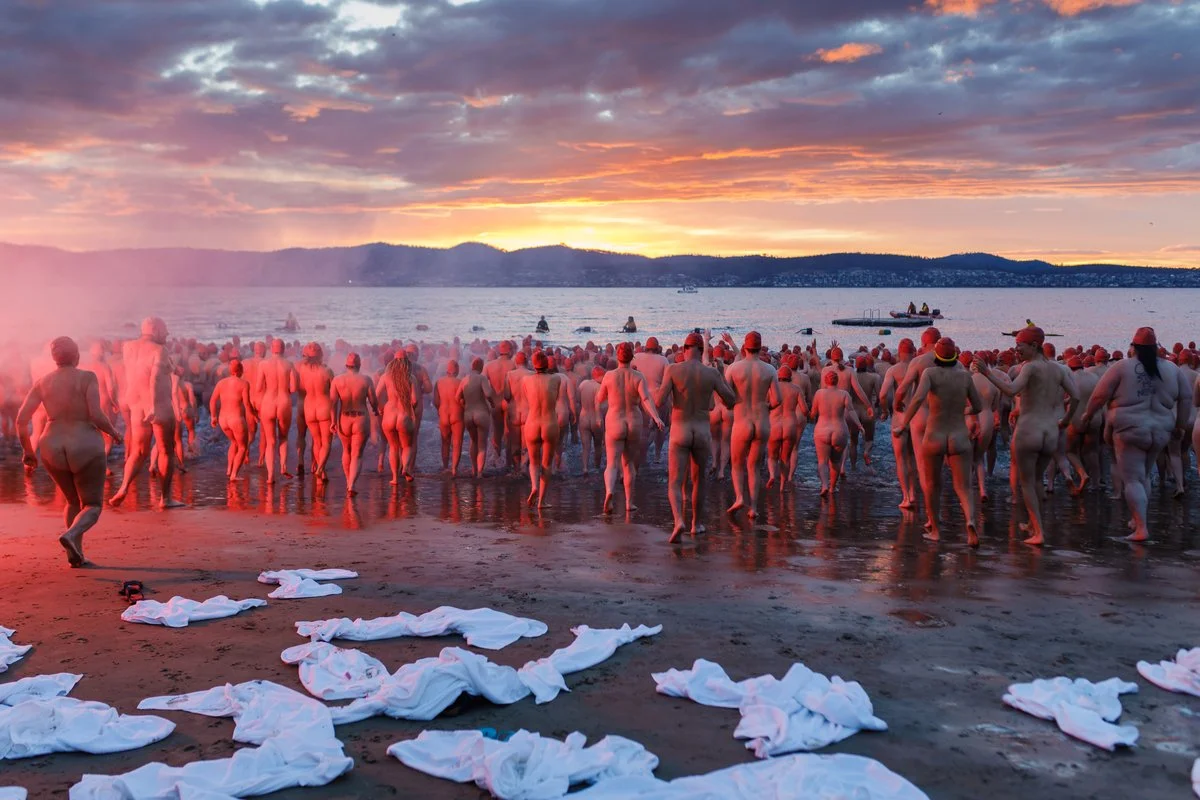
Before the scroll
Some evenings, before sleep, I sit with a book and let the noise of the day ease out. The phone stays facedown, out of reach. There is no sound but the occasional creak of timber and the thud of brushtail possums on the roof.
Lately I’ve been dipping in and out of The Book of Legendary Lands by Umberto Eco, full of imagined territories drawn by people naming what lay beyond what they knew. A map with a serpent curling through the sea. A garden in gold leaf. A coast drawn from stories alone. These maps rest in a time measured not by proof, but by possibility; by the human urge to reach for what’s just beyond sight.
Fermentation and flesh
One image from the 15th century stays with me: bare bodies draped over wine barrels, limbs tangled near fountains, a lake pooling at the edge of green grass. The scene gleams, almost sticky with abundance. People drink and lean into each other, their limbs lit as wine slips across skin. It looks profane, a feast that spills past its edges, and as the gaze holds, the weight of years presses in. Centuries lean close, a time in which ferment moves through the picture. The gleam thickens in hips and hands, in red that slides down a thigh, in liquid that breaks its vessel.
That night the painting stayed with me, pressed against the inside of my eyes, less thought than pressure. I could feel the shine of skin, the slick of wine, as if some trace had entered me. It lingered like an aftertaste, a flavour that would not recede. In that lingering, the bodies of another world seemed to move through this one. The image did not belong to the past alone; it lived in me, yeast at work in the dark. What began in barrels and hips rose again, clothed in another century’s skin. It is a force that stirs in the night, a residue that seeps through flesh and music, a ferment that asserts itself, that refuses to be contained. That ferment is measured differently today, by pace. In the 15th century, people mapped lands they had never seen. Now we chart with data, timelines and digital trails. The medium shifts, but the desire to reach remains – we still seek ways to touch what feels alive. Today, closeness disperses across screens. Gestures hover between presence and display. What once thickened in breath, in wine, in touch, now glides across glass. The passage beyond ourselves is rerouted through new circuits.
This impulse to break with ordinary time has always found form in feast, dance and gathering, in events that promise intensity, that pledge to draw us together where daily life wears through. At times the impulse gathers in festivals, at times in fleeting convergences that carry more than they contain. Whether or not we call it ritual, the ferment continues; reshaped, rerouted, yet finding form in the ways bodies lean together, in the intervals where presence is held in common. One expression of this ferment rises in Tasmania each June, when the island turns itself into a stage.
Night mass in Tasmania’s winter current
Each June, the compass tilts south. Tasmania draws like a magnet and becomes an island altar. Dark Mofo rises from the cold like a fever dream, part procession and part provocation. Thousands arrive with winter in their lungs, drawn by the promise of fire, sound and the annual nude plunge into the Derwent. It’s playful, defiant, elemental, as bodies throw themselves into the dark and the cold. Perhaps it is the shedding that winter asks of us: to meet in darkness, exposed, yet unafraid. Night Mass, one of Dark Mofo’s recurring rites, arrives each weekend like a tide. This year, I went alone. Not in solitude, but to open myself to the encounter. A small experiment in exposure. The experience isn't exactly a party. It’s more like a navigational riddle, a sensory wormhole pulling the body down spiral stairwells and through veils of light. Arrival is always deferred. Dancing happens, sometimes. But mostly, people drift. Not toward rhythm, but toward the disorientating sense that something more novel, more enticing is happening elsewhere. The night scatters rather than holds. It stretches attention, then snaps it back into hunger. In that play, it reflects the restlessness we carry into it.
In line behind me, two voices rang out like white cockatoos: bright, playful, carrying the warmth of somewhere else. They had flown down from Brisbane for this. Their chatter shimmered with anticipation, as if awe were already purchased. I smiled, offered small talk, mentioned I live here. But under that exchange, something in me smouldered: a craving, not for novelty, but rupture. I wanted to ask, tell me something weird. What woke you at 3 in the morning? The moment slipped past, drifting like everything else that night. Night Mass went on as it always does, incessant invocation without end.
The longer it went, the more I wondered what we were all here for. What we hoped to find. Perhaps that is the shape of Night Mass itself: an invitation to seek. But what are we seeking? In the thrum of it all, the body becomes a cursor, the brain a flashing tab. Neurons fire like strobes, not to illuminate, but to keep us scanning. Wanting becomes the currency of the experience, spent without measure. Presence dissolves into anticipation. Immersion is both anchor and undertow, each turn carrying us further from shore. That restlessness always needs fuel. At Night Mass, the fuel burns fast.
What we watch burn
One year, a car was set on fire as an installation. Flames licked the frame, orange veins threading across the metal, a slow unravelling. It looked like the world had ended or was rehearsing how to. People gathered in a circle, phones rose in unison. I had seen burning cars before, but in another context, one shaped by conflict, where a burning car was a warning, a scream. It meant someone was trying to be heard and was willing to burn something to make sure they were. There, it meant danger. Here, it completed the night, held within the safe perimeter of an artwork. Yet my body did not fully accept the translation. Heat on the skin is never neutral. Even without smoke, something settled on my tongue, a taste as if ash had slipped past the curation. The image sank into me, a residue that did not leave. What clung as residue also revealed the pattern: chaos carefully measured, motion controlled. Privilege let the crowd hold the image without carrying its risk. What elsewhere meant uprising, here in Tasmania became a backdrop to revelry. Bourdieu might have recognised it as a conversion of collapse into capital; struggle reabsorbed as aesthetic cool. And through it all, another combustion was underway: our attention. We spent it willingly, drawn to the glow, without knowing how much we had left. While our nervous systems spiked, overstimulated and hungry, whatever the chaos might have said dissolved before it could be heard. Night Mass is finely tuned to the restlessness of now: immersive, sensory, cool. It stages a choreographed descent, a one-night stand with ruin, without ever having to feel it. The end of the world made watchable.
Remains
I come back to Night Mass, year after year, drawn by something I cannot pin down. Maybe it is craving. Maybe it is chaos rehearsed as ritual. Perhaps it is the current of desire itself, fermenting, spilling, reaching beyond its bounds. It is not only the burnt car that remains with me, nor the sense of a world staging its own end. It is the way, in the swell of celebration, what might matter disappears. At a party, that surge feels natural, part of the play. At Night Mass, the scenes are different. They lean toward chaos, intensity, strangeness, and yet they pass as lightly as the rest. Their weight thins out in the overflow.
Some would say this is the point. Night Mass is a party, after all, and parties are not built to hold weight. Their power is in the blur, in the flash of a scene, the scream gone before it settles. The surge and the vanishing are what give the night its charge. But chaos is never only a thrill. Chaos lingers. It scars. It unsettles. When chaos is staged and then swept away in the same rush as play, something shifts. The rush turns against the depth it evokes. Wreckage becomes décor, struggle becomes backdrop. These moments strike for an instant, then dissolve, leaving only the taste of what could have lasted.
Their shortness is the thrill. But it is also privilege. Some can stage chaos, dance in it and walk away. Others live inside it. The thrill is bought by distance. If we can walk away, then the question is what we do with that distance? Do we let it dissolve as performance, or allow it to open toward another way of being with, one that might hold more than it consumes? What remains, faint, is the taste of ash after the night has ended. ▼
Image: Dark Mofo/Rémi Chauvin - WikiCommons
If you liked this piece, please share it. And please consider donating or subscribing so that we can keep supporting writers and artists.