
Boat building underground – by Linden Hyatt
ISLAND | ONLINE ONLY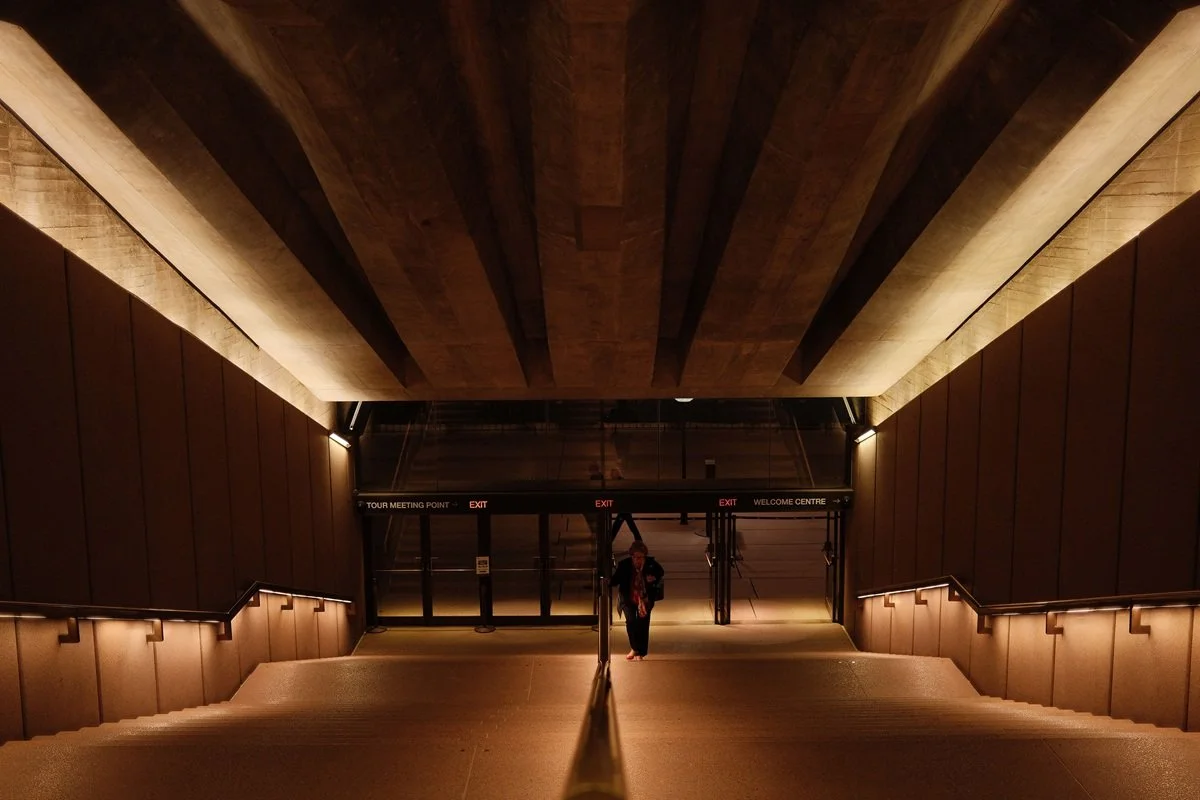
Skies over George Street towers were oceanic, harbour and ground turned upside down. The pro-Palestinian protest made orange mesh and water-filled barriers, even umbrellaed weekday crowds, feel more urgent in Sydney summer rain. Even the small group of Christian pamphleteers on the Town Hall corner seemed harried, competing with traffic on Park Street and megaphone chants and drums on George, a pulse Clara could feel low in her spine. Town Hall and QVB stops for the light rail to Randwick were cordoned off, someone explained. Her overnight just-in-case bag was heavy. It might have been easier, if she hadn’t been pregnant, to walk to Central, to catch it there. Yet everything merged and softened back underground, in the public fug of wet fabric and scent, down the steps, slowly, fearful again now, with people making space for her, to the crowded platform as a City Circle train arrives.
Then it’s always present tense. As if history has been evacuated down here – neon-gloss shopping colliding with ticket barriers – everything flattened into function, a purgatory of movement and delay.
The train on Platform 6 has stopped. Another train, not yet slowing, approaches Platform 5 where Clara stands, one hand on her belly, the other against cold wall-tiles. Then a man steps out from the people waiting, walks forward.
Did he run?
No – he just sort of walked. That’s how it happened.
And in that half-second Clara thinks: No need to step toward it. Simple as that – a note on a stranger’s impatience.
The woman immediately in front of Clara, whose wet wool coat Clara will later smell on her own hands, is holding a chip packet, lime and pepper. The woman reaches out – hey, care ... is on her tongue. Clara hears her own thoughts catch again on no need. The woman’s hand stays raised, fingers poised to touch, to grab and pull at nothing. Then it drops. Chips spill onto the platform.
A man on a bench near them retches; he too cannot turn away.
Time slowed. The train is braking still and will never stop.
Clara steps backward, stumbles over scattered chips. Someone reaches for her, but she runs – past the older man with vomit on his shoes being comforted by a uniformed schoolgirl, past a young woman who covers her eyes and screams, belated. Time warps. The only moving thing in memory is the train.
Heavy, up crowded steps, Clara’s bump is knocked by an unknowing elbow. She fumbles for her Opal card while people press behind. Up steps to George Street, by Woolworths, aboveground, is open air, yet Clara is pushed into the protesting crowd itself pushed into barriers with rows of armed, black-vest-clad police, and feels paralysed, unable to think from not having done something, but what; not having said something, but what; not having stayed, but why.
Let me help you, an older woman says, close and seeing her distress, hands her placard to others, helps make space, and Clara remembers her urgency at 34 weeks, the lack of movement since waking, not sleeping, advised to come in for a check. Can someone come with you, they’d asked? No, but my sister is coming from Kiama to meet me. I need to get to the Royal Women’s, she tells the woman, near shouting, Prince of Wales.
Forty-five seconds have passed.
On Platforms 5 and 6 railway staff tell people to stand back, move on. Others shepherd confused, half-knowing school children, office workers and tourists to exits. A bell rings continuously. Railway staff in orange high-vis vests lead people solemnly off the train stopped short on Platform 5. People are down on the tracks in front of the train.
A woman who felt that she had fallen under the train with that man watches this with a hand to her mouth, the other hand still half-raised, while a young man, a student perhaps, a traveller, speaks to her, wanting to help. He was a young man, like you, she says, as they are led away, as if she walks with a beautiful ghost. She will not be able to speak for days, will fear sleep, every night to wake, seeing again what she might have stopped.
Sixty seconds have passed.
Stand clear. Doors closing.
At Redfern Station, a southbound train on Platform 12 moves, then stops, as the Platform 11 train doors close. The train accelerates, next stop Town Hall – then after two hundred metres, it too halts. On one side rails veer toward abandoned buildings overgrown with fennel, brick facades of workshops, graffitied, town houses and terraces on the other.
Did you feel that back there? Lionel asks Else, their daughter between them.
Feel what?
Not sure.
The guard announcement arrives at one remove: Our apologies to CityRail customers. Due to a serious incident requiring emergency services at Town Hall a the City Circle service, next stop Town Hall Station, will be delayed.
The carriage hush. Fifty-five seconds have passed.
It feels like twilight too early – brooding, before streetlights flicker on.
Why has the train stopped? the little girl asks.
Someone’s had an accident, Lionel offers, then glancing at Else over little June’s head, says, a fatality.
Why, Mummy?
Must have been someone on the tracks.
What’s fatality?
When people die, Lionel says, embarrassed by his own bluntness. Fate. How to tell a five-year-old?
*
Beautiful ghosts are in those houses. They are on the road in cars, in trains, on buses, walking pavements unseen. Later, in the liminal moment between light and dark, people might sense grief and release, not knowing why, nor knowing what exactly it is they sense. They are cooking dinner. They are watching television. Scrolling phones. Paused or moving in traffic. They stop to look out a window, at empty streets. An inkling in which the present moment is coiled. Wet bitumen looks blue. There is an ocean under all this. Gadigal lands. Another world.
*
His father’s rifle is in Lionel’s hands. He steps outside with the gun, closes the back door, walks under the clothesline, into the shed, pulls the shed door shut. Stands in the dark with the moon in rusted-tin-roof pinholes. Switches on the light. Here in this place is stillness after vertigo. There is a part-built dinghy under a glaring lamp. Naked bulb. Naked life. Boat building in a small town. Just transom and frame, upturned, part skinned, a plyboard dream begun. Sawdust on a blueprint. Small details born anew. Pink-to-gold celery top shavings, wooden butter-curls from a plane, fallen to concrete splashed with red resin. Blue electrical tape unwinding from the handle of a hammer. Screws catch brass light, in a packet open, waiting.
The sky with rain, like leaves on tin at first, from the tall gum overhead.
And the thing itself. The boat.
He sits with the gun on his knees. The weight of it a burden. The handle curved to touch, wood-worn polish, the gun metal cold … and puts it aside. Sits, until birds sing dawn and he sees in that boat, in unpainted marine-ply, held in a curve by clamps, the Southern Ocean. Sees bull kelp rise in swell, a water forest. Watches rivers drop from granite before a leviathan of water … sees himself differently by what his father has begun, a becoming; wood to ocean, something infinite yet humble. Night in an inland town and yet he hears a sea gull outside. Walks out of that shed, sheepish, tired, frosted grass under bare feet his only witness. His mother thought he had grown angels’ wings after, from that secret reprieve. Quietly walked inside where people slept softly, put the gun back in a cabinet, slipped into his bunk bed beneath a sleeping older brother, both coiled fetal under blankets.
*
Five minutes have passed.
An inter-city train slides by—a Blue Mountains Mariyung, silver and orange livery, tinted window glass, oblivious.
Eleven minutes have passed.
Police ribbons cordon the platform. White light floods the tracks, like a film set. Camera flashes fracture time. It’s already online. Trauma on socials. Soon it will be a small story, lost in scrolling. Trains diverted, delayed fifteen minutes. National news covers protests that erupt into violence, police in military rows charging, squabbles and fists on phone footage.
June climbs onto her father’s knees. Else checks the app again. They are meant to catch the Randwick Light Rail from Central. A gift-wrapped heirloom blanket rests on Else’s lap, the gift of optimism that doesn’t stop worry. She checks her messages, thinking she must surely have missed a call or text from Clara.
One day I’ll build a boat, Lionel says. This little fella can help. I’ll show her how.
Else looks at him, then smiles – a flicker of compassion and annoyance.
A funny time to think about building a boat, she says. And anyway, we don’t have a car. How would we get it to water? ▼
Image: TalhaResitoglu - Pexels
If you liked this piece, please share it. And please consider donating or subscribing so that we can keep supporting writers and artists.