
Outer Banks – by Kathleen Williams
ISLAND | ONLINE ONLY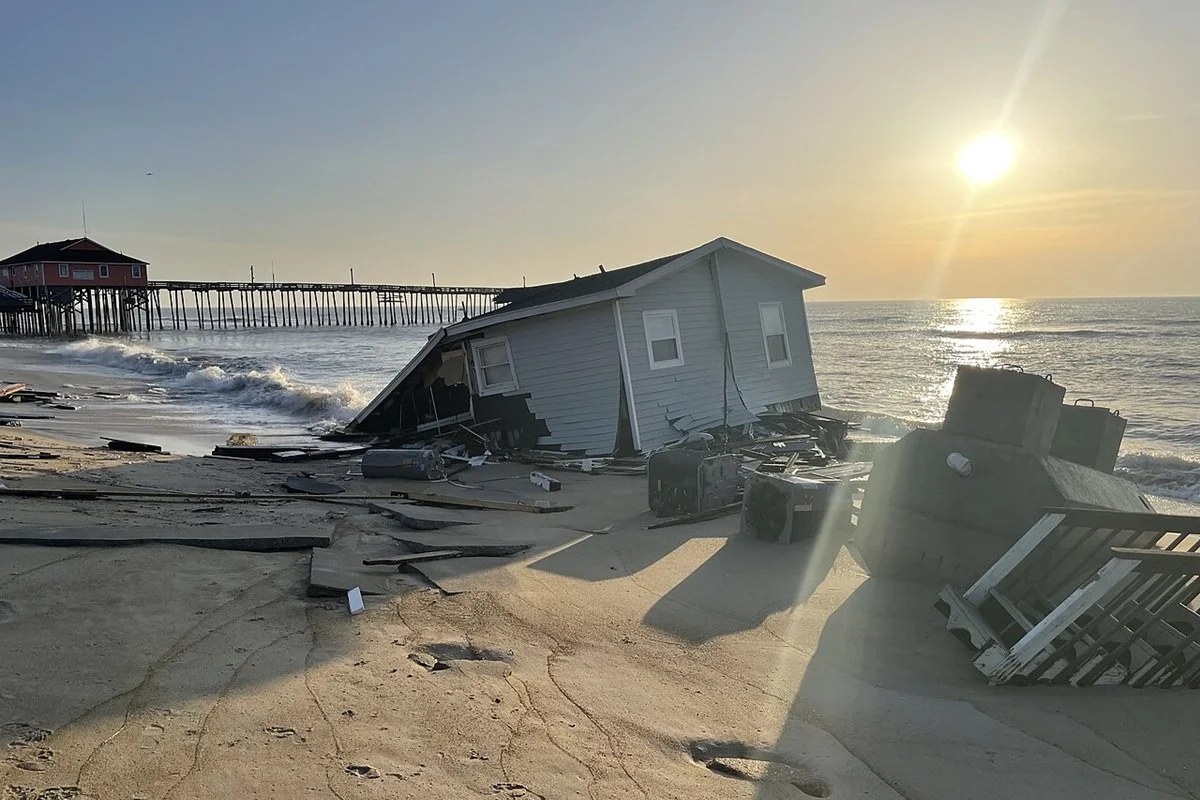
Six houses collapsed into the ocean on the Outer Banks, a series of islands off North Carolina, between May and November 2024. In this area of the world, strips of houses that were once on solid ground find themselves on sand due to coastal erosion. I discover these houses through TikTok. Their immense, shuddering structures collapsing into the ocean are captivating, seductive. I wonder if it’s somehow appealing on a class level, if we’re all hiding smirks while watching the upstairs gentry implode from the downstairs quarters. The houses are enormous, teetering on stilts like circus performers staring down the sand. People on stilts are generally horrible, so it’s easy to wish the house’s demise. Each lapping wave is an invitation for destruction, and if waves are certain to do something, it is lap.
As a teenager I was on LiveJournal, a diary-based site that also had community pages. One community I lurked around was dedicated to sharing photos of abandoned buildings. These would typically come from two places that see themselves at odds with each other: the United States and Russia. The Russian photos were often the most impressive but also the most stylised. It was a point of contention in the community for the photographer to include themselves in the photos, and Russians were – by my memory – the most likely to include themselves. The photos were highly saturated. Buildings strangled by vines seemed to give off breath among the debris of the next jettisoned project of the Soviet Union. By comparison, the abandoned buildings from the US told an entirely different story – of houses left in an utterance, with bills and paperwork littering the floor. Bags were hastily packed, beds now stained with the presence of others, who could make something out of the structure in its period of transience from home to ruin. Sometimes, there was enough personal information left behind for the house tourists to find out what had happened to the family. These houses were typically in areas of impoverishment – either new or ingrained. In the following years a blog went viral for having before and after photos of houses in Michigan (and specifically Detroit): one photo at the heyday of the motor industry or even just before the financial crash of 2008, and the second photo following the destitution that ended with desertion. These houses seemed to rapidly change from neat, ordered, impressive two storey homes that proudly announced themselves to the world, to hunched and hidden structures, barely perceptible as houses. Detroit became a kind of abandoned place pornography. Endless streams of images of a place in perpetual ruin. Trenches of foreclosures.
Abandoned houses are naturally imbued with a sense of loss. If personal items have been left behind and the house has been left to rot and decay, it’s not for a good reason. The objects that make up a life are hard won, particularly when you love objects for the sake of objects. Typically, these abandoned house images are outliers, framed by financial crisis or political abandonment. Then the environment, which doesn’t care one bit about political or financial crises, ties the two together.
Decades later on TikTok, I see someone enter one of the abandoned houses on the Outer Banks before it collapses into the ocean. Our voyager does a voiceover for this video, and it’s far from the detached removal that was preferred in the now-retired LiveJournal communities. We watch in POV, the cameraman’s legs becoming our own, as we head up into the stilted home. Waves crash underfoot and underfloor. The front door opens with no resistance into a house whose form has been flummoxed by water. Walls and ceilings are missing but with no perceivable logic; a reminder that not only is the water below, but it also around and above and in.
Any abandoned explorer will tell you that going upstairs is something no-one should do, precisely before they themselves do it. Walking along beams is a preferred trick of the well-initiated, but when a house is swaying into the water, those precautions fall out of favour and the window. We go up another floor again, this one almost roofless; the shell of the house a conduit for water, a temporary island built around the water it carries and briefly resists. The gulf in the ceiling seems to invite water in, challenging the sky to tear the house open from the inside. This is a house intent on destruction, self-sacrifice to the elements. Every extra footstep is outstaying our welcome.
How does a house get remembered? How does it get condemned? Houses such as the few teetering over ocean in the Outer Banks are abandoned before they are destroyed, leaving the wrecking to be done by winds and water, and houses are falling into the ocean with greater frequency because climate change is speeding up coastal erosion and allowing it to cast its net wider. As people walk along the beaches that suspend these homes, they walk along a condemned alley. The coast just as temporary as the house – our new shared timeline.
When the house does go into the ocean, it hasn’t been entirely cleared of its contents. Junk drawers still hold blunt scissors, a mug sits full of old pens waiting to be tested before being thrown out, outdoor furniture weathers quickly. As NPR has reported, the reason for leaving a house largely intact is twofold: that clearing it can be dangerous, but mostly that there isn’t any money to demolish it. The homeowners certainly aren’t going to cough up cash to bring about its ruin prematurely. When the houses collapse into the ocean, so too will the debris of the lives of those who lived there. So too will toxic chemicals, wood, plastics, mattresses, ceramics, plasterboard, insulation, and whatever engineered fabrics and materials make up the skeleton of a home. All of this bursting into the tides and currents, either ending up castaway on an island of garbage with other trash to break down eventually and join the silt at the bottom of the ocean, or to end up on other shorelines, a disembodied offering, sent off to some other place outside of care’s shadow. Once it’s gone, it was never there.
In horror, there is a consistent trope of the house in decay. The former beguiling mansion or castle becomes a site of refuse, of interiority, of haunting. The crumbling house occupied by the local witch (read older, single woman), spectres or other human monsters, bleeds into otherwise mundane, suburban landscapes. Joshua Comaroff and Ong Ker-Shing talk about the contagion that a ruined house threatens. With neighbourhoods destroyed by fire, landslides, floods, and other ‘natural’ disasters, the collapse troubles the order of faith in structures and infrastructure. Houses go from a place of refuge to a logic of horror: the contagion of disaster lapping at our heels.
The collectivity of disasters and crisis is now coming to define the age we are living in. Termed poly-crisis, mega-crisis, meta-crisis among others, this age of the expectation of disaster is often levelled at the site of a destroyed home. Homes are, after all, our most meaningful places. Their belly is full of cables, pipes and metal, but a disaster unearths them, rendering a house less about the comforting elements of the home than the monstrous, living self.
The shoreline, like bodies, is committed to the project of change, and its change is coming about more rapidly, forcing its limits further and further onto what we perceive as land, reordering our thinking, changing our borders. This is often seen to impact upon a few – sometimes imagined as wealthy property owners, other times by Australia’s recent leader of the Opposition, who says of our Pacific Islands neighbours, that ‘time doesn’t mean anything when you’re about to have water lapping at your door,’ and who, the erroneous and horrific implication goes, deserve to bear the brunt of climate change. But he also showed his card: an acknowledgement by the house that climate change exists. As these changes take place, they will have much broader impacts, and it is maddening to think that it will take conversations about insurance premiums increasing to get people to think materially about the relationship between our actions and our future.
I learn that the insurance industry – an industry built around profiting from crisis – is now itself in crisis. Hard to imagine that they didn’t see this coming. Turns out that there’s a delicate balance to the amount of crises you can profit from, and if there are too many crises needing to be paid out, then the industry itself will be in a tandem crisis with the rest of the world – strapped together, hurtling towards the ground, with a parachute that won’t open. Able to see the unfolding crises from above, unable to stop it, and refusing the see the connections between. ▼
Image: Cape Hatteras NPS
If you liked this piece, please share it. And please consider donating or subscribing so that we can keep supporting writers and artists.