
The humming – by Meisha Simpson
ISLAND | ONLINE ONLY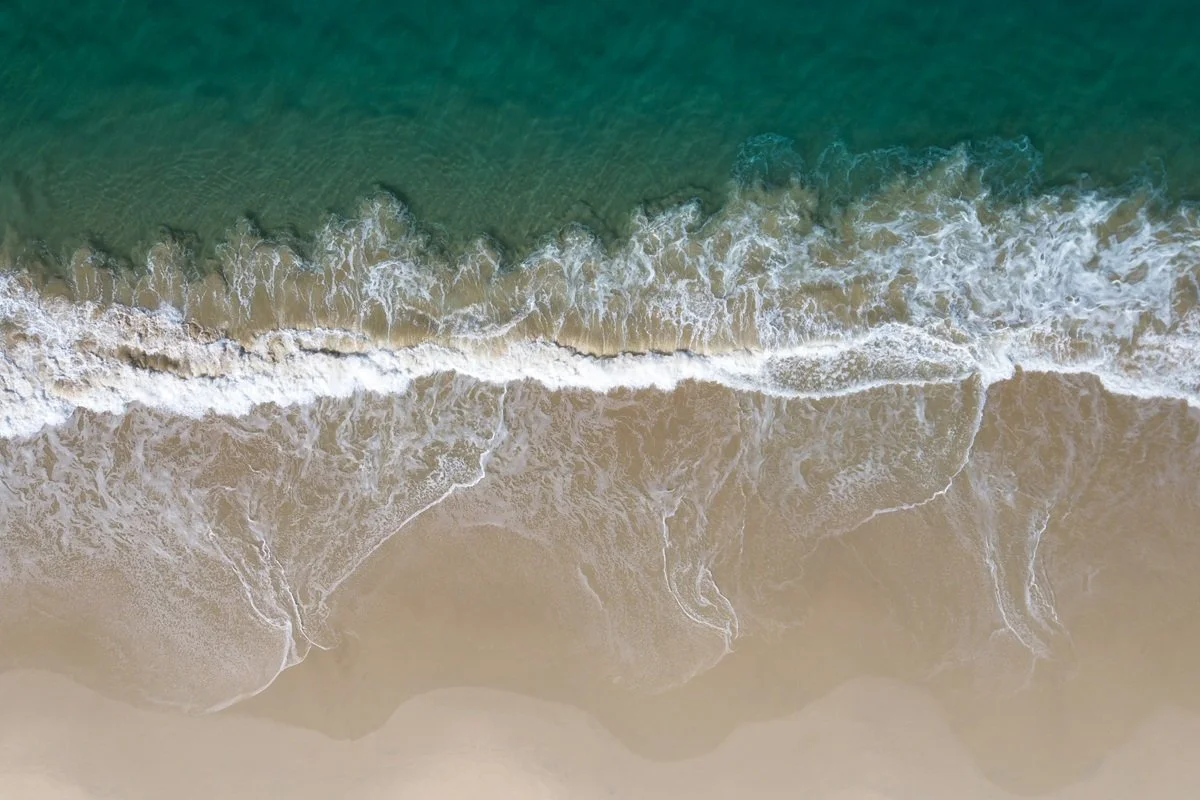
In the sea, a wolfish grin. The oily head of a seal, whiskers dripping and twitching. The wave, curling the seal with it, one body in motion. Flex, release, and slide with the wave like a seed from a pod. Rolling water, shattering, splintering.
On the shore, a boy and a girl. The boy is on his knees, digging a hole. The girl is brushing sand from her wet purple tights. There’s a dark shape to the left of them, a lump of brown, scaly with sand, a golden strand of seaweed like a wreath on its head.
The tides won’t be as big as last week, the boy said.
I don’t want him to get washed away!
He won’t get washed away. Promise! We’ll go extra deep… see? And he keeps digging.
At the end of the cove, a crust of rocks, itched and prodded by a family of pied oyster catchers. A couple of kelp gulls shift lazily around the kids, curiously inching closer to the backpack of food, forgotten on the wet sand.
In the water, two surfers. A woman with long dark hair, nose piercings and a bright blue wetsuit, a man, with his gloved hands on the surface of the water. I always forget how stunning it is here, the woman says. Our hands in the sand, the shapes we made between the rocks and the seaweed. The man smiles. Nothing’s changed, that’s for sure. I see your skin against the clouds in the sky, your fear of thunder, something sharp and bright.
On the ferry this morning, the woman got out of her car to stand with the wind on her face, to feel the cold under her skin again. Looked south to the craggy wet mountains and felt their heavy gaze. She recalled the side of a bus in the city, advertising tourism at the Female Factory, plastered with black and white faces of convict women. She saw her face in those folds of skin, felt her feet humming with the engine of the ferry, this body of water that was split with oars made from ancient forests. The D'Entrecasteaux Channel, a passage of removal, crossed by Trukanini in resistance, a woman her school told her lies about. She knows more now but not better. Open your mouth and breath the air your ancestors settled for. Spit it out with a cough and flee.
I think that’s enough. The boy pokes his head out of the hole, there is dirt on his face which is round and sun browned. A fresh scar on his chin from a recent fall. The girl is nodding, pleased, proud. Both turn to the rump of the dead seal. He’s definitely dead? The boy asks.
Definitely, the girl says solemnly.
He is starting to smell, the boy agrees.
And he has no eyes.
They kneel down at the seal’s side. The girl pulls her fluffy sleeves to her elbows. They put their hands on the seal and push. The seal rocks slightly in the sand. The body heavy. Like it’s full of water, the girl says. Or rocks. The boy considers and they try again. His bare feet claw into the sand and he runs on the spot to hold his grip. The seal rolls a little but they relent and it rolls back again. We could pull him, the girl suggests. Slip some seaweed around the middle. The boy nods. But they can’t get the weed around the heavy body and when they do, it snaps at the first pull.
Out at sea, a seal pops his head up, resting on the surface of the water. Raises one fin to the sun, soft with the current, waiting for the whales to arrive.
I’m thinking of moving to Ireland, the woman says after paddling back from a wave.
What? His eyes are smaller, brighter in alarm. The rip tugs at their bodies and they drift out to the point together. There’s an internship going on the west coast. It’s a great opportunity. When will you go? How soon? The rip is tight around them now and the man looks over his shoulder at the shore and starts clawing towards it. Big cold water there too. White water on the cliffs. Gulls on the updraft, hovering, waiting for release. The woman feels the pull of the water, how it could send her spinning. The shadows of the mountains scare me here, the shapes beneath the surface. The silence in the forests on the beaches in the oceans when she arrives. In a couple of weeks, she calls to the man. Gives me some time to say goodbye to everyone, and she paddles to catch up with him. You’ll be great over there, he says when she is drifting beside him again, and he means it. Something we dug up from the depths of the sand and made precious, rinsed slowly by the tides. They sit close in the water now, the water breathing all around them. Their knees bump together, though they don’t feel it, a thick layer of rubber between them.
The two kids look at the dead seal together, intent on finishing what they started. We need to get him in the hole, she says.
My dad always uses levers when he needs help, the boy says.
Like a seesaw?
Exactly.
Driftwood! And she runs off to the top of the tideline.
Good thinking, the boy says and runs after her. The tideline, a black crust of rocks and rotting seaweed, karkalla spreading from the soil in the dunes. Where shells are packed in the dunes in layers of charcoal and wallaby bones. Where the kids rummage through the coastal debris, voices squawking until they find a gnarled and barnacled old plank.
From a ship! The girl says excitedly. I read about the French at school. They sailed around here for science.
Dad said there was a jetty down here in the old days, the boy says. For whaling.
Probably good it’s from a jetty, the girl says. The boats probably didn’t like him.
This seal wouldn’t know the French boats or the whaling boats, he’s too young, the boy says.
But his family would remember and would have told him, she counters, and the boy tries to think of the seal family, tries to picture it. Do you think he would rather be washed away or in the sand?
Away from the birds, they’re hungry, the girl whispers, pointing to the gulls. They drag the plank over to the burial place, the wood humming through the grey sand.
A limb of black rock beckons the lines in, tearing them open and sending them splintering, curling to shore. The man bobbing in the blue, the woman, somewhere, gliding on water. The only people in the world. The man likes it. He feels the familiar teeth of cold water, the constant shifting of the wind, the peace in the expanse of the bay and knows he is home. There’s a couple of shacks on the headland now but apart from that, it’s been the same since he was a kid. A few farms, sheep and cows among the gum trees, a few rattly utes, barking dogs. Like the old days. Like it should be.
The old plank of wood is the perfect lever and this time the seal rolls into the hole. When the body hits the bottom, there’s a loud thump and a thin crack. The boy says, yes! And the girl says, what was that?
That crack?
We broke him! We broke the seal’s bones!
We can’t have! He’s covered in blubber, the boy says.
The hole was too deep, he fell too far. The girl is on the edge of tears. The boy gives her a pat on the back. He’s safe now. The birds won’t get him in the sand. The girl nods, sniffing and wiping the hair from her face. And he has his wreath, the girl consoles herself.
Yeah, the boy says, seriously, though he doesn’t really know what the wreath is for. The girl made it while he was finding a good digging stick. My digging stick! The boy said
What?
The seal, he fell onto my digging stick. I left it in the hole. He feels a bit sad. It was a good digging stick.
Oh! The girl’s face brightens. We didn’t break him.
He’s safe.
He’s saved.
Did the waves always crash here? asks the girl. The boy was telling her how his uncle surfs the point. He stops at her question. Well, he says, the swell hits the point and that’s how a good wave is made. How long have the waves been hitting the point? she asks. She shelters her eyes with her hand, staring out at the water. The waves have to be older than the rocks. The boy shakes his head, puzzled. The waves roll, peeling around his beloved point. The point he would surf all his life. And each time he paddles out, he thinks, consciously or not, how long the waves had peeled here. When the girl starts to surf, the boy takes her out to the point. As they sit there in the rocking water, he asks if she remembers that question she asked him as a kid. She shrugs, I think about that all the time with waterfalls too, how long the water has been falling. The boy feels confronted. He had thought that specific wondering, that shared thought about deep time had been theirs. But he could never catch up to her, those looping thoughts and feelings. Keep chewing the cud, his grandfather had said, as in stick to your guns, as in keep to your strengths. So, he sticks to thinking about how long the waves had hugged this cove.
The headland used to have a hat of scrub before the farm was extended. Now the cows graze near the windswept edge where the gulls nest in the oranging rock, unfazed by the spitting mouth of the southerly swells. The seal doesn’t mind the birds. Sometimes he tries to see how close he can get to their bellies on the surface, but he is more curious about the black limbs of the surfers, their hard plastic bodies and excited yells.
On the wet shore, the kids cover the seal in sand. They work together. The girl sniffles a bit and the boy’s mouth feels gluey and thick. Oh! Look at this! The girl, suddenly animated, holds up the tiny vertebrae of a seabird that had been buried in the sand. The boy makes an excited sound but he feels uncomfortable with her eyes wide on the fragile skeleton. Little bones lined up on the windowsill, shells chipped and chalky, an old gumnut, the sweet berry smell from her laundry, sticky like the anxiety that rises when he smells it. The girl lays the vertebrae gently on the sand. Behind them, the waves are messy and crumbly. A couple walk a dog up the beach. As they pass the kids, they call, impressive hole! No shovel too!
I used a digging stick! The boy calls proudly.
Nothing like a good digging stick, says the woman and the boy grins.
What’s the hole for? The man asks, leaning over to take a look.
A seal, the girl says matter-of-factly. We are burying him properly. The couple look at each other.
Oh, the woman says and she steps away from hole. Shouldn’t this seal be left on the sand? Isn’t it food for the birds now? The girl looks at her confidently.
We have to care for the animals like they are our friends. I wouldn’t leave my friend to get eaten by birds.
Fair enough, the woman says.
Have you kids got a lift home? the man asks.
Yeah, my dad’s working just up the road, the boy says.
Weather’s coming in, you’ll get wet in the arvo.
The kids look to the sky, to the thick clouds on the horizon. The sky is still bright though, so they shrug and the couple continue up the beach to the carpark. They fill the hole with sand and the girl makes a heart shape with shells on the mound then covers it in kelp. Kelp is the lungs of the ocean, she tells the boy. Now the seal can breathe down there.
Water all around. Slashing rains on the surface of the ocean, spray shattering. Kelp whipped and whirling in the blue foam. Golden forests shrinking as a hot current wraps around from the east. The world cracks open and there’s the moon above the headland at the far side of the bay. Small boats shelter in soft harbours, the fish in rocky nooks. And in the sand, two kids alone, sheltering and mourning a seal they called their own. When the weather breaks, little silver boats head out to rocky reefs to plant golden seedlings in the deep. Trying to keep the southern oceans humming.
Remember when we got stuck here? When we buried that seal? the woman asks. Her eyes are stinging from the sea spray, her body soft and slow with fatigue. The man drifts beside her. We weren’t stuck. Dad was just around the corner, working at the farm.
Oh…I remember thinking we were the last people on Earth, like we were stranded there or something.
Really? We were here all the time as kids.
Huh. The woman pauses. She thinks of that wreath of kelp, that string of amber with its rubbery leaves and seeds. I think maybe that seal meant a lot to me at the time, she says and the man nods. I remember that much. He thinks of the point, the hours he has spent here. How she made him think of the constant energy of the coast place. How he feels guilty for burying the carcass and how now he’s more scared of seals than sharks. Like he’s expecting some kind of revenge. He felt annoyed at the girl’s insistence to meddle on the beach that day and those feelings riddle him most surfs. But there’s a familiarity in that and it makes him think fondly towards her. A consistency of feeling, that’s what’s important.
Was it weird what we did? she asks him.
With the seal? We were just kids.
But what do you think about it?
It’s a good memory, I think. One of the only clear ones I have as a kid. Just something to hold onto, you know.
She smiles at him. We were weird kids.
You were a weird kid, he says.
True, she grins. You were very hospitable of that.
Of course, he says. Mum would have disowned me if I wasn’t.
Classic Clare, she says, and with a sinking feeling, she turns to look out at the offing. He wishes he hadn’t said anything and keeps quiet from then on. The beating life on the wind, the harsh blue water and silver trees bent in knots of their own. I’ll miss it here, she says. Being watched and felt and listened to, her skin pricked by rain and sand, an autumn breeze short of breath, wrapping her hands around a warm cup at the farm, something to hold on to.
The sun behind the headland, the boy looks to the distant car park for his dad’s red van, listening for the familiar grumble of its engine. The seal now beneath a bed of sand, the girl wanders across the beach, forever on the lookout for a nautilus shell. A spiral to follow and hold, your whole world here on the island. The beach grows quiet, tide snoring on the sand. Kelps gulls wheel by the cliffs. A pair of hooded plovers jog along opening lips of water and land. The boy lingers near the seal, wondering if he will ever find a digging stick quite as good as the last. My hands on wood and water, transforming tree to home. This home of his, a coastal island claimed and changed. A small bay with a point, a blanket of water he returns to. The girl, her care heavy and clinging, the farm they grew up on, coastal birds and cows. The soil that was pressed into their skin since they were babies, footprints deep and present. Soil that remembers flames, blood and seeds. Sand that remembers bones and wood. Something that holds. Something that hums. ▼
Image: Graham Holtshausen - Unsplash
If you liked this piece, please share it. And please consider donating or subscribing so that we can keep supporting writers and artists.