
Extinctions – by Dani Netherclift
ISLAND | ONLINE ONLY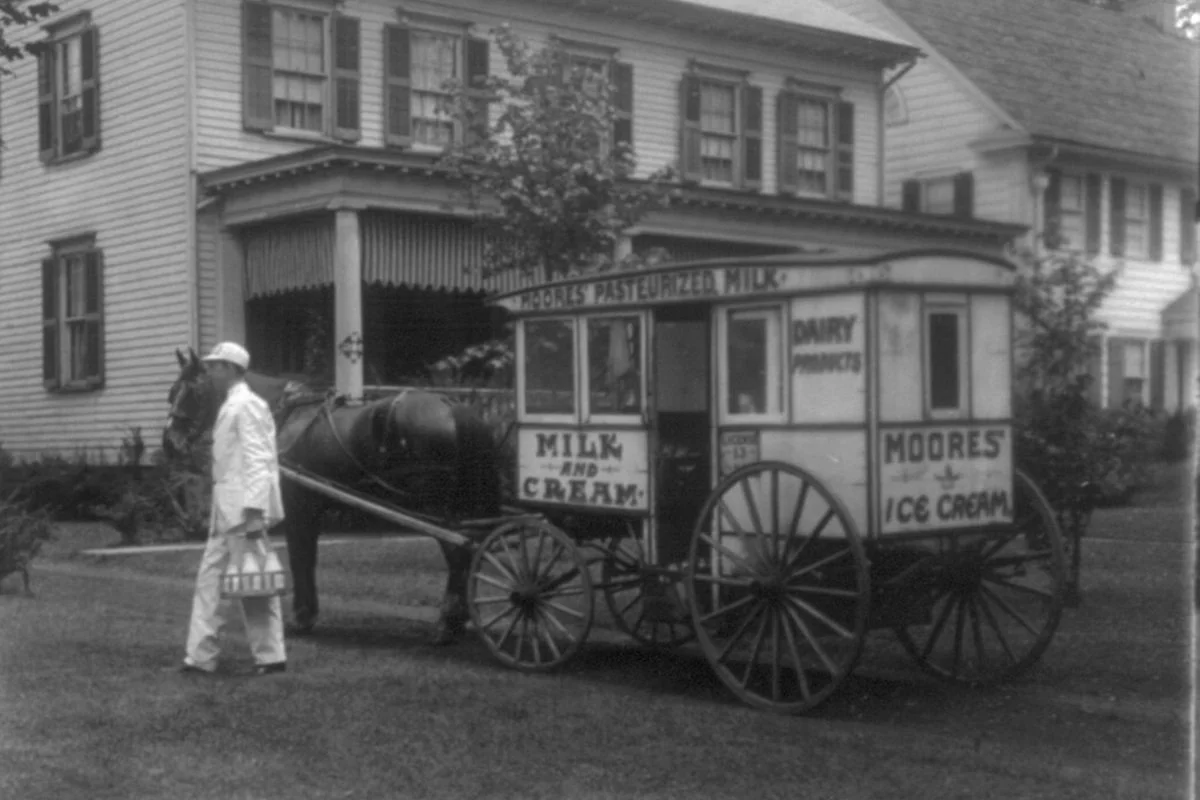
The threat AI poses to writers and the art of writing seems to have arisen swiftly. Who threw open those doors? What is an entry? A door is an aperture to possibility. These are important concerns for a lyric essayist. There are so many ways in (and out), so many connecting silences in between. What does it mean for your calling to become extinct?
~
[lamplighter.]
~
Though the idea of artificial intelligence was long philosophised about, it wasn’t until 1957 at a workshop at Dartmouth College in New Hampshire that the seed for the future of AI as we know it today was planted. From then on, things progressed at a steady pace in many ways, but I don’t think anyone foresaw it coming to take the jobs of writers away from them. It took this long for some capitalist mind to light up in that way.
~
[milkman.]
~
AI can tell you what a lyric essay is, or at least what it does. Though when I ask it to write one about itself, it can’t apply the nature of its aggregated knowledge to form. Instead, it generates a very lyrical essay.
~
A friend who works in marketing says she will steer her children away from skills or professions that can be carried out by AI. In this friend’s position, high up on the corporate ladder, AI already informs her hiring proclivities. Many jobs she used to employ writers to complete are now carried out by AI. It’s cost effective for her company, she says. My daughter is best at – and most loves – to draw and to write. She has taken after me in some ways. She is not a strategic child, and unlike my friend, I am not one for guiding my daughter toward some other, more prosaic line of futureproofed work based on what AI can or can’t do.
~
[switchboard operator.]
~
The lyric essay contains lostness. Holds it. It is an aperture between movements. A space full of the resonances of the unwritten, things that can’t be known or written. It bears the weight of untold stories. It is a comfort for that, a salve for what hangs on the hems of oblivion.
~
In his Red Hands Files #248, Nick Cave addresses the question of AI. Cave writes that the intent behind it is to do away with creative processes altogether, to cut out the messy and inconvenient work that impedes the heart of the thing – the product. It begs the question, Cave says, of what the value of the product is without the process.
~
[knocker-upper.]
~
Not only does ChatGPT not know how to compose a lyric essay, it also has no knowledge of precarity, no memory for past hurts, old breaks, or what can be lost. Artificial intelligence cannot hold and set down and thereby preserve the memory…
(of my brother diving into the amber flow of irrigation channel waters before drowning…)
(of the feel of my newborn daughter’s skin, wet as a fish…)
(of the sounds of whispered singing to my grandfather on the day he died…)
~
The Australian poet Judith Bishop wrote in Island magazine in 2022 about the quality of continuity or infinity as represented by joy. AI, large language systems, cannot express the simplicity of these kinds of continuity, the value or essence of the ephemeral, because it can have no sense of what it is to die, to know that nothing lasts or remains static.
~
[nightsoil collector.]
~
In 2023, fiction writer Holden Sheppard wrote an article denouncing AI as ‘our generation’s asbestos’. In the article, Sheppard calls for the immediate banning of AI in the creative industries. The rapid rise of AI potentially sketches a swift blueprint for the extinction of creative writers, poets, painters, musicians, screenwriters, actors.
~
[sin eater.]
~
Writers in Australia make on average $18,000 a year. Many creative writers rely on forms of corporate writing to sustain their creative work.
~
An Australian company recently won a $600,000 grant to investigate merging AI with human brain cells to improve the ‘memory’ of AI, despite various research and development bodies warning of the catastrophic existential risks.
~
[video shop employee.]
~
At the beginning of the US actors’ strike that joined force with the writers’ strike, SAG-AFTRA President Fran Drescher stated, ‘If we don’t stand tall right now…we are all going to be in jeopardy of being replaced by machines’.
~
At the time he died, my brother worked in a video shop. He used to let me borrow my favourite films for free on the proviso that I also watch classic films of his choice. This knowledge sits without place or significance in the world, without currency, yet here it is, reconstituted from ruin. A shred of fragment.
~
[scribe.]
~
One reason that corporate managers might favour AI systems for writing is that it is able to produce work instantaneously. Humans require time to do the same job. Time is money. Most writers do their best work not for business but creative purposes, but their labours are usually not valued highly enough for creative writing to sustain a writer financially. Time is crucial to a writer.
~
In a lyric essay, time might be represented via the compression of association. Years might pass, back and forward in the spaces between words.
~
I wrote a PhD on the elegiac lyric essay. Those people who say they won’t allow their children to follow the paths of jobs AI can do would consider I have wasted my time. Those years, precious to me. Invaluable.
~
[town crier.]
~
Everything my brother did in his graphic design degree was performed by hand – pen and pencil strokes, paint and stencils. He left behind sheaves of transferable letters. I found them in a chest last year. I rub their surfaces, transferring black and white letters onto pages of my writings. They assume the shapes of ghosts.
~
Around the world, 500 animals have become extinct in the last 100 years. The white spaces of this page teem with absences/extinctions/ghosts. Everything connected.
~
[gandy dancer.]
~
A lyric essay meanders. This form is replete with gaps, fragment, non-linearity, repetition, association, sometimes image or marginalia. It braids and weaves or mosaics. Makes a whole of broken pieces, hints at open wounds and unfinishedness.
~
[lector.]
~
This lyric essay is a collaboration. I have joined hands with the enemy in asking it to write a lyric essay that it doesn’t yet have the resources to compose. Still, via the attempt, I have trained it. And in so doing, this one query has consumed 519 millilitres of water and 0.14 kilowatt hours of energy, according to research conducted by The Washington Post.
~
[elevator operator.]
~
ChatGPT and other large language systems don’t really ‘write’ anything, let alone curate and reassemble the fragmented pieces of a lyric essay – they merely predict text. They don’t comprehend the loaded spaces of gaps between words.
~
It’s difficult to know what the people who held the positions listed here made of being rendered obsolete. They were livelihoods, and important for that reason. Writers will never become extinct because they will write for its own sake, but getting any credit and payment for their work might become vanishingly rare.
~
[linotype arranger.]
~
There are lines, drawn in sand. What is it to be human, to express human desires and losses? Hélène Cixous theorised that to write was mostly not arriving.
~
[telegram messenger.]
~
I have been told more than once that there is no such thing as a lyric essay. We keep not arriving. But surely that is the point.
~
Ways of being and doing. The art of practice.
~
Anders Monson once wrote he wasn’t interested in reading about people’s lives or things that had happened, he wanted rather the art that writers bring to storytelling. The complexity of their constructions. Their thinking through of a thing. Those roads.
~
On March 20, 2025, The Atlantic reported on LibGen, a pirated database of millions of books and academic papers that Meta had used without permission or payment to train its AI model, Llama. When I checked the database, I found the name of my book, Vessel, a longform elegiac lyric essay about the deaths of my father and brother. It is worth noting that when I check, AI still doesn’t get how to write a lyric essay.
~
In France during World War I, my great-grandfather won the Military Medal. After, he worked as a sleeper cutter, cutting down trees for railway lines in Victoria’s north-east that no longer even exist.
~
Most of the job suggestions for open positions that keep getting served to me as a Doctor of Philosophy are to train AI systems to write better.
~
[Keener.]
~
To write an elegiac lyric essay is to enter and write again your grief. To enter and re-enter. To continue thinking and writing and wandering through what it means to echo again these losses. How repetition changes meaning and adds resonance. To keep entering through different thresholds, to meander, as Anne Carson says, into a room whose walls and windows are completely comprised of entries, seems to be a uniquely human endeavour.
▼
Image: Library of Congress
If you liked this piece, please share it. And please consider donating or subscribing so that we can keep supporting writers and artists.