
Where dead animals go - by Ruby Perryman
ISLAND | ONLINE ONLY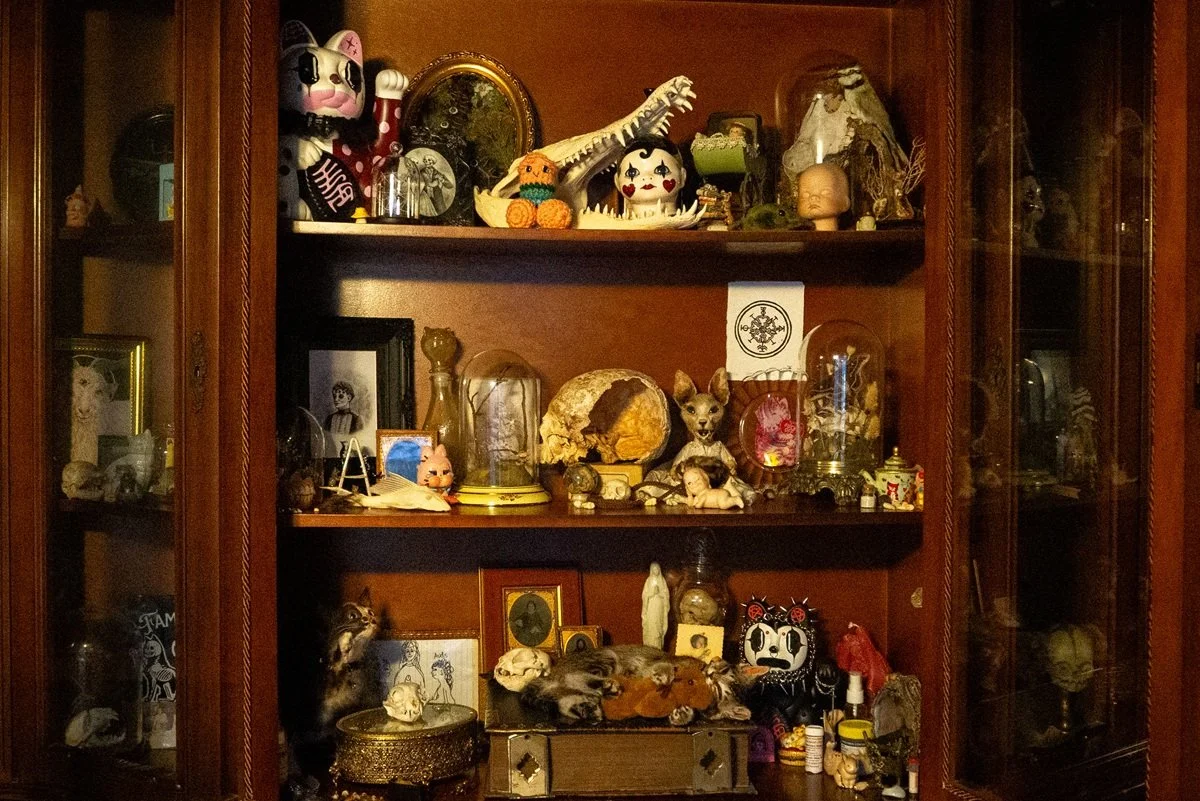
When Audrey Ko was eight years old, back in Singapore, she noticed a taxidermy duckling sitting in her grandma’s cabinet. Her mother told her not to touch it – it was dirty, probably diseased. ‘Oh, it’s an animal,’ Audrey thought. ‘How did they do that?’
When Audrey was 13, her hamster died. She had quite a few hamsters, but Oatmeal was her favourite. Remembering her grandma’s duckling, she called some local museums to ask about taxidermy, but they paid her no mind. So, Audrey made Oatmeal into a shoddy wet specimen – that is, she preserved it in liquid. The standard would have been to use formalin, but as it was highly regulated in Singapore, she ordered isopropyl online as a substitute. Audrey’s mother kept a safe box in the house at the urging of her feng shui master. This is where Audrey hid Oatmeal, her most prized possession, until the day her parents, horrified at finding Oatmeal floating in a jar, threw her precious wet pet away.
‘I think I’ve always been a little strange,’ Audrey says, sitting in her work room, now 30. A silver chain hangs from her large, square spectacles, jangling as she speaks. She’s rocking a burgundy mullet and fluffy leopard print pants. Late afternoon light falls softly on matte black wall paint and a sea of small faces. A grey rabbit named Dream is perched on a Styrofoam stand on the wooden table in front of us. Dream has no eyes, just a little mouth pulled up at the corners in a sweet smile. On a side cabinet are two blue-eyed kittens, carefully pinned, waiting to dry on their mounts.
Taxidermy is one way to examine how humans value animal life – especially domesticated animals over strays. In August 2025, a Danish zoo posted a callout for pets to be donated as food for the captive carnivores. The post sparked debate around the world – no one wants to imagine their pet being tossed into a panther enclosure. Biologist Clifford Warwick told The Guardian, ‘The entire thing is bizarre and wrong … It’s a horrendous devaluation of animal life.’ Would it feel less bizarre and wrong to feed the carnivores wild or stray animals?
Audrey works full-time at a kennel. In her downtime, she runs a taxidermy operation called Familiars of Hel. She does pet memorial commissions and works with animals that don’t belong to anyone, like roadkill, which she collects. What her trolls see as Dahmer-esque, Audrey sees as a practice that helps people process grief, or honours animals that have never been loved before. ‘People are weird about death,’ Audrey says. ‘It’s such a big part of our lives, whether we like it or not. Instead of fighting it, this is my way of tying it all together.’ Or, sewing it all together.
Taxidermy is a lengthy process. Most animals come to Audrey frozen. Then she thaws them out in her fridge – yes, next to her vegetables. When she brings the animal to her table, she does a pre-preparation ritual. ‘I hate the word praying, but I ground myself and start work with love and gratitude,’ she says. ‘There’s no science to it. It’s just me being present with them.’
Next, the animal is skinned. Seeing an animal with its skin off is like seeing a wall without cladding – it’s uncomfortable to know what’s underneath. The skin goes through two cycles of salting to draw out moisture, before being submerged in a pickling solution. Once enough flesh and sinew fall loose, the skin is tanned, turning it into a leather of sorts.
Audrey passes the bones onto collectors and people in the animal preservation community, who use them for things like jewellery. The organs and other insides are cremated by a small independent business. Taxidermists use different materials to shape the form beneath the animal skin, such as cotton, wood, wool, wire. Audrey works with a process called casting, using the carcass to shape an exact replica. ‘This is gonna sound silly, but I try to sit with the animal and think of what its personality is going to be,’ she says.
When the skin is mounted on the cast, Audrey starts sewing. A perfectionist, she takes her time, going a bit cross-eyed by the end, sometimes pricking her finger with the needle. Then the animal sits to dry. Weeks later, she adds finishing touches – some pink pastel paint in the ears, or brushed over the nose – to restore warmth, a reappearance of life.
Of course, Audrey would rather see animals alive. ‘A lot of my animals are quite young, they haven’t had the chance to live,’ she says. ‘It might be very, like, saviour complex of me, but it’s creating something meaningful, creating art, from animals that would have just laid by the roadside and not gotten any aftercare.’
In Melbourne, animals that die in public spaces are the responsibility of local councils. A representative from Merri-bek Council told me that when a dead animal is on a major arterial road, VicRoads gets involved. Animals hanging from electricity wires, usually possums, are removed by the power company. Those found in waterways are referred to Melbourne Water. Any cats and dogs are scanned for microchips and stored in a freezer. Bar those picked up by loved ones, all dead animals end up in landfill.
For decades, City of Melbourne Council has contracted a service provider called Spotless to handle street cleaning. When a dead animal report comes through, the Spotless team has an hour to get on site, and they embark, with shovels, masks and gloves. ‘Once we’ve picked it up, if there’re a few stains on the road, I’ll get somebody there to wash that area so there’s nothing left,’ says Spotless supervisor, Garth, when we speak over the phone. I hear happy children, voices tinny in the background. I ask if this work is emotionally taxing. ‘A lot of people struggle with it, but I think because they know it’s part of the job, they kind of get used to it. The guys think of it like, “We need to get that out of sight of the public, especially children.”’
When I ask Audrey the same question, she says she cries a lot. ‘I think the death part, like the actual organic material of death, I’m quite desensitised to. But the emotional side and the spiritual side of death is, yeah… I don't think I ever would get over that.’
The first dog Audrey taxidermied for a client left a lasting impact. He was 40 kilos and she struggled to carry him to her table. ‘I do cats all the time and I’m a cat lover, but there was just something about that dog. I’m about to cry thinking about it.’ I wonder if it was the sheer size of him, a form edging closer to our own. ‘It’s even harder for me dealing with animals that don't have a home to go to.’ She gestures to a tiny white kitten behind the glass of her side cabinet. It wears a collar with a bell, stretching eternally in ‘melting heart’ pose. ‘Bug, I’m pretty sure was attacked by a dog and just left to die.’ She gives all her animals collars and name tags, so they know they’re wanted. She says this might be influenced by her Chinese Singaporean culture, in which paper houses are burnt for ancestors, sheltering them in the afterlife.
When her parents came to Australia to visit and saw dead animals in her fridge, they weren’t particularly pleased. ‘I think part of why I pursued taxidermy was to prove to myself that, despite these very complex cultures and the upbringing I was rooted in, I can be someone outside of that,’ Audrey says.
Like her animals, she’s lived many lives. She’s worked as a physiotherapist, which she originally moved to Melbourne to study for. She’s delved into competitive power lifting, spending six days a week at the gym. At one stage, she tended to hundreds of live tarantulas, cohabitating in her apartment. ‘I remember when I first moved here, I would only hang out with the Singaporeans in my uni. I look back at that, and look at my life now, and I know so many people from different walks of life. Taxidermy has opened a lot of that up for me.’
Emma Craddock, a friend of Audrey’s, describes her as the queen of taxidermy. When I knock on the door of Emma’s unit, I’m met with immediate barking. Inside, framed spiders, beetles, butterflies, and other insects of all colour and variety litter the walls. Emma shows me a wet specimen – a stillborn pug puppy, curled up with eyes closed – given to her by Audrey. She holds it gently, with a manicured hand, sporting a silver, bone-shaped ring on one finger.
Emma is a professional dog walker and is looking after an excitable Aussie shepherd, who is all over us until being escorted into a different room. We sit on the couch, which is covered by a hairy grey throw, and Emma’s pet pug Ducky settles in my lap. Breath wheezes out of Ducky’s sweet, squished face, so heavy I worry about the quality of my audio recording.
Emma collects bones. It started with a rat skull she found in her house in her 20s. Now, she has several cabinets full. ‘I understand it’s not for everyone, but I think it basically came from a love of the natural world,’ Emma says. She grew up on a farm in rural Victoria, where animal remains were a normal part of life. ‘My dad was quite used to me being like, “Can you come help me get this carcass off the side of the road?”’ Her father and friends now text her whenever they see a dead animal, to check if she wants it.
There are a couple of ways to clean bones. One is by using a colony of dermestid beetles – flesh beetles – to eat away the meat. Another is letting the carcass decompose, securing it either above ground – Emma uses a metal cage – or burying it deep into the earth, so scavenging foxes can’t get in. Then the bones must be macerated, which means soaking them in water to pull out fat and grease, doing water changes over weeks. This is the worst part, Emma says, tipping out the liquid death. Finally, the bones are cleaned with hydrogen peroxide to return them to the right colour.
I ask why Emma thinks more people don’t view dead animals the way she and Audrey do. ‘Everyone’s too busy doing their own thing. Like, “Oh, I just hit a cat, but I’m going to keep driving because I’m late to work,”’ she says. She shows me the skull of one of her father’s cows. Preparing it was rough – she wore a mask and wrapped her face in a t-shirt sprayed with perfume but could still smell the brain. The end result was worth it. ‘I knew that cow, you know? So I think it’s really special I still have her skull. As macabre as that sounds,’ she laughs.
When Audrey’s cat Georgie died, she had her taxidermied by someone else – she wasn’t confident enough working with cats at the time. She asked Emma to clean the bones. Emma felt honoured, and while she respects Audrey’s decision to have Georgie taxidermied, she doesn’t think she’d be able to do the same with Ducky. ‘That wouldn’t bring me comfort. People deal with grief completely differently.’
Back in Audrey’s taxidermy room, Georgie sits in the corner watching us. When I ask about it, Audrey gets emotional. ‘If I could go back, I would have done her myself,’ she says. ‘It would have provided me with a lot of closure, I think.’
Managing grief plays a large role in Audrey’s work. ‘I have lengthy email exchanges with all of my clients, even if it’s just to talk about their pet or how they’re feeling. I love working with people – it’s community. It’s that shared connection about grief, which is such a heavy thing to feel alone.’
The sun is starting to set. Audrey offers several times to drive me home, but I don’t want to impose. After some back-and-forth, I agree to a train station drop-off. We head out of the taxidermy room into Audrey’s tidy, suburban home, and put our shoes back on at the front door. As I climb out of her white SUV in the station carpark, she leans over the passenger side to ask, ‘Sorry if this is weird, but can you let me know when you get home safe?’
The train is running late. I’m alone on the platform, apart from a glossy, jet-black raven, one bung wing hanging loose by its side. I watch anxiously as it edges towards the tracks, eyes fixed on the opposite platform. It gears up to fly. Don’t do it! Before I can intervene, it glides, lopsided, and lands safely on the other side.▼
Image: Ruby Perryman
If you liked this piece, please share it. And please consider donating or subscribing so that we can keep supporting writers and artists.