
Blokes throwing bouquets – by Yves Rees
ISLAND | ONLINE ONLY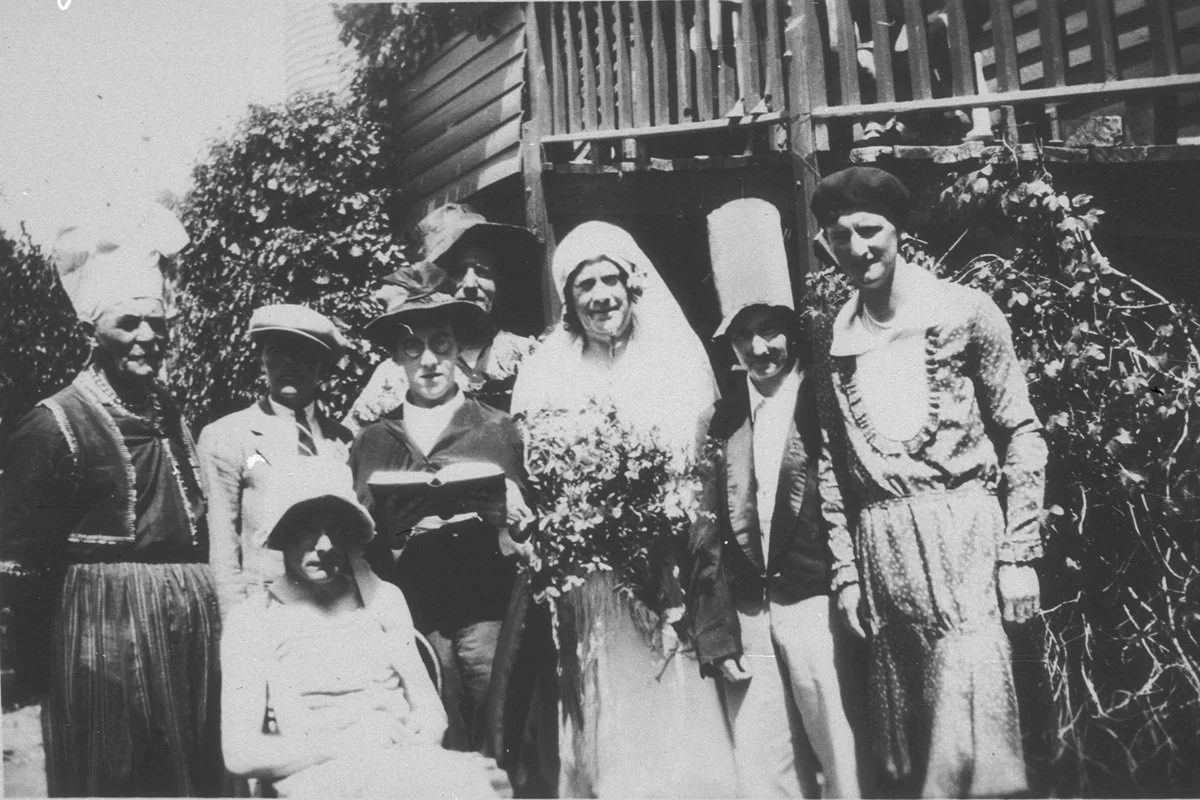
The bride was cleanshaven and clutched an oversized bouquet. Bushy brows, eyes modestly downcast, white frock straining against footballer’s shoulders. To the left, the besuited groom. Only a slip of a thing, claiming extra inches with a Panama hat. Beneath the brim, a pallid face covered by dark glasses and a fake beard. Encircling the happy couple, the wedding party posed for an official portrait, all squinting into the glare against a backdrop of sun-bleached eucalypts and corrugated steel water tank. It was 1933, deep in the Depression, yet wedding bells had today enlivened the tiny community of Gunbower – a Victorian township just south of the Murray, on unceded Yorta Yorta and Barapa Barapa land.
Only these were no ordinary nuptials. Those footballer’s shoulders? They were the real deal. The fake beard? It provided what nature could not. And despite the pomp and ceremony, this coupling was sanctioned by neither God nor state. It was instead a mock wedding, a vernacular pantomime characterised by cross-dressing and gender inversion. Burly blokes mincing about in wedding gowns, young ladies butching it up in borrowed suits. It was drag, that queerest of artforms, and it was all the rage among the upstanding citizens of settler Australia.
From at least the 1890s until the 1980s, from Perth to Launceston, Noosa to the Adelaide Hills, Melbourne to Rockhampton, respectable men and women decided to swap clothes and get pretend-hitched. Although sometimes staged as a private party, the mock wedding was typically a public event, a participatory mass ritual that often doubled as a community fundraiser. In its heyday, during the early 1900s, it happened virtually everywhere that people gathered: church groups, children’s homes, sporting clubs, university campuses, military units, women’s clubs.
Where did it come from, this antipodean simulacra of the marriage plot? Its precise origins are undocumented, but there are several likely sources. British pantomime, American vaudeville – both theatrical traditions littered with drag characters, each of which exerted powerful influence on Australian culture. Another possible source is North American folk tradition; by the late 1800s, cross-dressed mock weddings were a regular feature of community life in Canada’s Great Plains and the American West, often staged in conjunction with real weddings or anniversaries.
In Australia, the mock wedding developed its own conventions, helped along by locally published scripts such as Will Andrade’s The Mock Wedding (c1900). On this continent, it was typically a standalone event, unconnected to bona fide nuptials. Stock rituals were performed: exchange of vows, speeches and wedding breakfast, throwing the bouquet. In more elaborate stagings, a jilted lover might appear to mount an objection. Sometimes, the mock wedding was a same-sex affair, with an all-male or all-female cast. Other times, it was a co-ed occasion, with men and women swapping roles. Always, it was a jolly occasion, an opportunity for audience and participants alike to kick up their heels in service of a worthy cause.
Newspaper reports attest that a good time was had by all. It proved amusing and provoked much laughter. A very enjoyable time was spent by all. It was a lot of fun. A most enjoyable entertainment. Caused much merriment. Men in skirts? Bearded women? Good clean fun for young and old. In photographs, bride and groom beam at the camera, giddy with the thrill of it all. Teeth exposed, cheeks dimpled – the joy is palpable. To a modern eye, habituated to the dour faces of old photograph albums, it is almost uncanny to see such animation rendered in black-and-white. These figures were pillars of the community, respectable denizens of White Australia with reputations to protect – were they truly allowed to be so playful, so silly, so outrageously camp?
During these same years, cross dressing was criminalised in Australia. Professionals could get away with sex impersonation on stage, but civilians caught in the ‘wrong’ clothes were treated as felons. Especially for male-assigned people in female attire, discovery usually led to arrest. John Watson, 1925, arrested in women’s clothes on St Kilda Beach. Neville McQuade, 1943, given two months hard labour for ‘impersonating a woman’ in Sydney. Cross dressing itself wasn’t technically illegal (except in Tasmania), but gender deviance was policed via state-based vagrancy laws. Sometimes, gender crossers were institutionalised – as happened to Edward de Lacy Evans, confined to Kew Asylum after his female sex was discovered in 1879. Men in skirts? Women in trousers? Deviant, criminal, a threat to the natural order of things.
Except when it wasn’t. At the mock wedding, forms of gender crossing otherwise met with state violence were condoned and even celebrated. Here, before the eyes of the community, you could drag it up to your heart’s content and receive nary a raised eyebrow. This was because the mock wedding was a type of event known as a carnival: a mass social ritual in which ordinary restrictions are suspended. As theorist Mikhail Bakhtin explains in Problems of Dostoevsky's poetics, during carnival, life is ‘drawn out of its usual rut’ and ‘turned inside out’. For a limited time only, you can break the rules without censure; indeed, misrule is the whole point. Gender, class, race – the usual categories get muddled, binaries inverted. The deviant becomes normal, for a day.
But is this gender transgression or simply mockery? After all, the burly brides of the mock wedding bear more than a passing resemblance to present-day footballers, whose propensity to don skirts has been described as ‘an aggressive action that diminishes femininity and women.’[i] Sometimes, footy drag and mock weddings were literally one and the same – as in Eumundi in 1958, when a beefy club footballer mugged up to the altar in blonde wig and lace veil. This ‘hetero-masculine drag’ is, for researcher Joanna McIntyre, a ‘homosocial practice in which femininity is not only belittled but also becomes the currency with which men’s bonds are negotiated.’ In other words, cross dressing as misogynistic satire, far from the radical potential of queer drag.
And yet. What of the joy evident at so many mock weddings, almost childlike in its sincere delight? What of the women and children? The mix of genders and ages, the playfulness of it all?
We have limited evidence to go on, as the documentary record is sparse and most surviving photographs are devoid of context. But could the mock wedding, with its carnival-logic of authorised inversion, function as a portal into liberatory gender play? Might it offer temporary reprieve from the suffocating confines of normative masculinity and femininity? The mock wedding was indeed a mockery, but perhaps that ‘joke’ operated as pretext for acting on illicit desires. Historian Robin Eames notes that in settler Australia, ‘joking’ gender transgression was ‘one of several pathways to narrative redemption.’[ii] If you’re taking the piss, you win a free pass. You get away with things, can taste forbidden fruit in plain sight. In another study of all-female mock weddings during World War I[iii], historian Nadia Bailey characterises these rituals as moments of ‘transgressive rupture’. When women dressed as men and faux-wedded other women, they accessed a site of queer possibility in which it was socially acceptable to claim masculinity and perhaps explore same-sex desires. In Gunbower and elsewhere, what unnameable yearnings may have been given free rein under the guise of humour?
When viewed against the violent masculinism of settler Australia – where ‘real men’ were diggers and bushrangers and sportsmen but never expressive or soft, and women were damned whores or God’s police but always doormats – the mock wedding was perhaps beloved because, not in spite of, its latent queerness. For everyone, no matter their proclivities, those queer possibilities provided a pressure valve, a collective time out from the punishing work of performing ‘man’ or ‘woman’ according to the narrow strictures of the settler state. For a few short hours, otherwise was possible.
Certainly, it is striking that the mock wedding appears to have flourished exclusively in settler-colonial contexts: Australia, Canada’s Great Plains, the American West. In each society, the strict regulation of sex and gender was essential to Indigenous dispossession and settler conquest. On both sides of the Pacific, the colony needed heterosexual couplings to occupy land and grow populations; it demanded model families to sustain the purported supremacy of white Christian civilisation. And, in all three contexts, settlers loved to don drag for kicks. Coincidence? Or a shared strategy of reprieve necessitated by the violent theatre of laying claim to stolen land?
When Pauline Hanson jumps on the bandwagon of gender fearmongering, and decries ‘transgender insurgency’, she would do well to remember that gender crossing is baked into the fabric of ‘monocultural’ Australia. Aussie blokes have always worn frocks; you couldn’t keep them away. Queerness is not some foreign Other that threatens the settler nation; rather, queer possibilities lie at the heart of our vernacular traditions. The call is coming from inside the house.
But all carnivals must come to an end. By definition, the mock wedding was a fleeting affair, an exceptional activity that redefined and upheld the norm. This momentary misrule opened a Pandora’s box of possibilities yet, via its temporary nature, also reinforced the straight and narrow of everyday life. It was at once stick and carrot, sanctioned disorder that kept order in check.
Please explain? Pauline might ask. I don’t like it.
Oh, Pauline, we’re on the same page for once. You don’t like it? Neither do I. ▼
[i] https://research.usc.edu.au/esploro/outputs/journalArticle/Respect-and-Responsibility-Hetero-Masculine-Drag-and-Australian-Football-Culture/99449269502621
[ii] https://ses.library.usyd.edu.au/handle/2123/34879
[iii] https://press-files.anu.edu.au/downloads/press/n13384/pdf/01_bailey.pdf
Image: State Library of NSW
If you liked this piece, please share it. And please consider donating or subscribing so that we can keep supporting writers and artists.