
ISLAND | ONLINE ONLY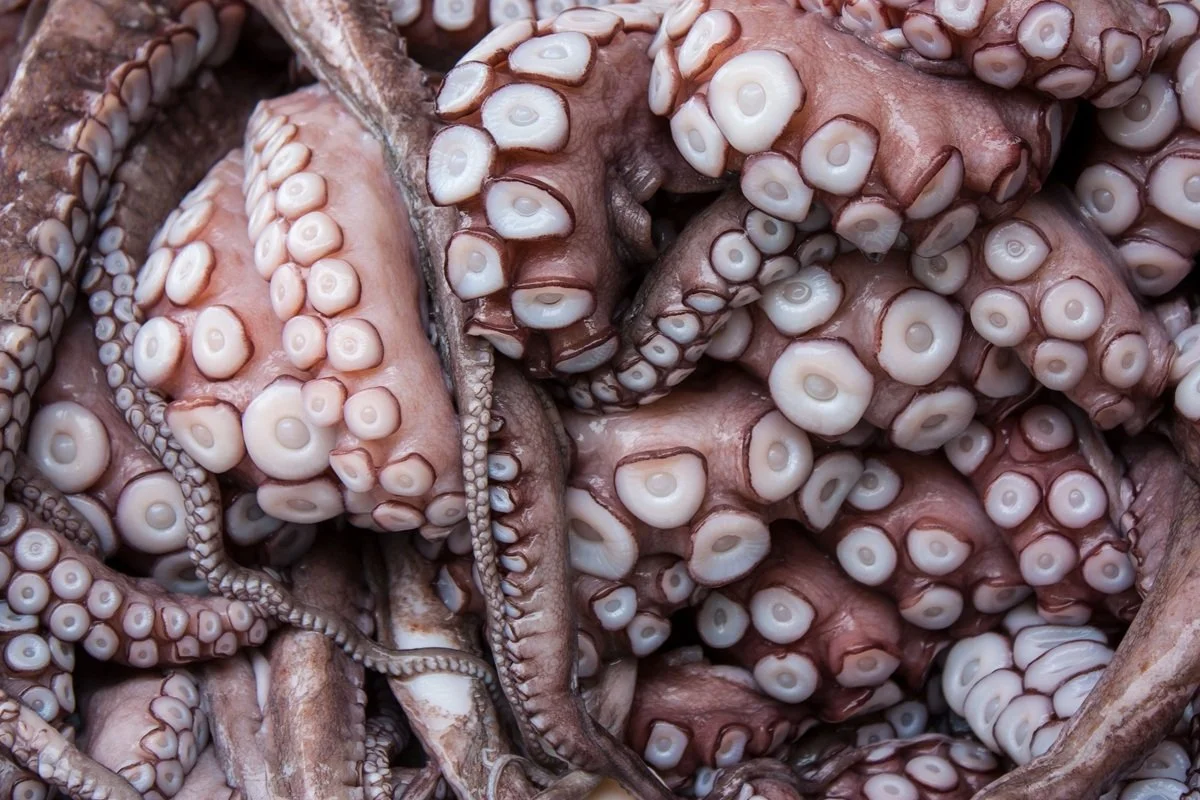
A Venetian homage to Hokusai
Christian orders for me. It’s his treat. We are in the trattoria where we once saw the actor Willem Dafoe from behind. We thought we recognised his sharp flat voice. This was confirmed when he and his entourage filed out and, his mouth gaping in a laugh, he glanced at us. We are here because Willem Dafoe is our lucky charm. This afternoon Christian struck gold. He clears out dead old ladies’ apartments all over Venice, loading their knobbly furniture onto his company’s long ribbed boat. Today he found a batch of rings in a rolled-up sock behind a bottom drawer. It was in his deep pocket in an instant, and now we are rich.
Christian knows I can’t eat gluten so although he orders clams and mullet roe spaghetti as a first course for himself, he tells the waiter I will be having the second course only. He wants me to try the octopus and chickpea cream, with baked potatoes from the island of Sant’Erasmus. He says for second course he will have the fried mixed seafood, which we know is made with the lightest of batters, a stack of lean whitebait, golden prawns, baby squid, and mussels. Christian grew up here so he speaks this language of sea creatures, knows where in the lagoon they congregate, slipping through which emerald currents and roving sand bars. He knows where they fish for octopus at the mouth of the Brenta, where the sweet fresh water coils into the salty wall of the sea. The octopus writhe along the silty bed and are hitched into the bellies of boats, small eyes engulfed by the light, an interlacing of glutinous arms.
We close our menus and the bushy-bearded waiter walks off. No sign of Willem Dafoe. But that doesn’t mean our luck has gone elsewhere. Before, at the house, Christian poured the rings into my palms, wanted me to feel the weight of the gold. It was heavy. We looked at inscriptions inside each. These were mostly worn off and there were only silvery curlicues we could barely decipher – Giov nni – C olina – 1 9 – in e erno. Christian placed an amber ring on my finger and the gold felt soft like lard, smooth like warm, loved skin. There were a couple that had clusters of diamonds, each stone with its cold violet chasm. And other stones we did not know, but we knew. We slid the rings on and off then Christian tied them in their little velvet sack. He, too, hid this where there was a panel missing behind the cupboard.
Our dishes arrive. What I hadn’t thought to expect was a pale long tentacle swept across my plate. Bone white, just like the underside of a child’s limb, but dotted with suction cups that dwindle to the tip, which has a burnt, resisting kink. Christian asks me what is wrong. ‘Nothing,’ I say. The chickpea cream is arranged in small circles along the plate rim, and the brown potatoes to the other side. Christian says to eat before it gets cold. I draw up my knife, deciding to cut a slice at the wide end where the tentacle has been severed from the body. I cut through, eating the meat quickly, tasting little. I cut another slice. This time one of the suction cups slurs across my tongue. It is still gluey, redolent of the lagoon tide. Christian, his fork bearing a golden loop of calamari, says it’s perhaps a little undercooked. I fork up a baked potato and push it through the sauce. I decide I will have to eat quickly, without letting the suction cups rove around my mouth. They are increasingly charred as the tentacle tapers towards the end, rimmed in salt and therefore more benign.
As soon as it is done I wash the meal down with two balls of ice cream, one made with olive oil and rosemary, the other with aloe vera and honey. While I am sitting there as Christian goes to pay, I feel that the arm has reassembled itself inside of me and lies bone-white, severed, a long arabesque in the pit of my stomach. I am aware of its form and weight. We go out into the night to walk along the Riva. Christian holds my hand and smokes a cigarette. When we stop for a drink with friends at the Rampa, something changes. The others are talking, but I can feel the tentacle inching into the regions of my body, sliding around my organs with a gentle grip, curling around the lengths of my bones, slipping into my bodily cavities from the inside melding her wetness to my own.
She stretches and expands as though I have given her back her life.
When we are in bed Christian falls asleep and snores loudly and I orgasm, again and again. The flesh should be rotting, breaking down in my system and moving through my intestines. Instead I feel the rolling bulb of her head inside of me, she grasps the nerve endings there, all of them in her brainy fists, and I am exploding.
In the morning I empty my bowels fully and I know that I am rid of her. Is this what has occurred? I have expelled the flesh I chewed and swallowed, each of the suction cups that teased my tongue and was pushed in spasms through me. I feel defiled when I remember my strong orgasms while Christian snored. Do I feel defiled? I look up ‘octopus’ on the internet, watch a video of a great old dame barrelling across the seabed somewhere, arms stretching and shrinking back, the lolling head crafted along. I watch closer, seeing the tiny tips reaching out, how slightly they grasp, pulling the fluid body so that the creature is displaced. This is the moment when tentacles ripple through me, the suction cups pressing down upon my insides, and there is a ragged tinkling inside my wrist, between my buttocks, along my scalp. I am wet all morning as though I am wading through lagoon water up to my hips. At work in the toilet I clutch myself, controlling a snort, as a wave powers through me.
I want to tell Christian. Say, ‘You know that octopus I ate last night?’ He would understand if I told him about the spirit of an animal, especially a creature of the sea. But I am the one who consumed her. She belongs to me.
Christian has taken the rings to a guy in Mestre and brings home the cash. He saves one ring. It is possibly the best. He says he is going to toss this ring into the sea, on the Lido. Everyone, even those who come from far away like me, knows that story. How each year the Doge sailed beyond the lagoon in his almighty carved and gold-embellished bucintoro, to cast a ring into the sea, marrying her. Then Napoleon invaded and dismantled every symbol and custom of the Republic, stripping the gold from the glorious vessel, outlawing the Doge, dismissing all the nuns in convents then erasing those buildings to make French parks. The beloved bucintoro became a floating prison and was later burnt. And when the ship was rebuilt, and the Venetians housed her in her cathedral-like bay within the Arsenale, Napoleon had the great stone opening narrowed, so it could go nowhere. Christian tells me these stories when I am buried in his chest. I think all Venetians have them written into their souls.
Christian can tell there is something different with me. ‘You’re hot,’ he says, ‘do you have a fever?’ I tell him I feel feverish, for this is the truth. I know I am waiting for him to fall into his heavy early night sleep as I feel a stirring inside of me. We have sex and Christian falls asleep, releasing me from his arms.
I pulsate and groan, this time I feel a tentacle crawling outside of me, making gentle exploratory steps on my belly, where she flattens and sucks the skin. I feel astounded, grief-stricken, I try to pile other thoughts back into my head. About Christian telling me he will buy his own boat and we will set up something. About how we’ll get married on an abandoned lagoon island, just us and the storks. But it doesn’t work. I plunge into myself and I am grappling with eight arms and the hard pluck of her beak.
The next day Christian is up early making coffee and brings me a cestina di ricotta di pecora in bed. It is creamy and barely sweet, with a drunken dark cherry on the top. I place the last rind of butter crust with a smear of cream in Christian’s mouth. He then goes to the cupboard, handing me my bikini and asking if I’ll wear the dress he likes with embroidered bell sleeves. I lace up the espadrilles I was wearing the day I met him. We catch the vaporetto to the Lido. I know what is in Christian’s pocket, tied in a small velvet sack. While we are sitting on the boat he places my hand there on his hip, so I can feel the gold circle. A different girl might wonder why Christian is not sliding that gold circle along my ring finger, but I would just as soon become his bride with a ring of plaited grass. I would just as soon become his bride with a ring of plaited grass. Christian and I don’t need any more than that. And I know, for him, this gold ring belongs to neither of us. I love the way Christian’s beliefs go beyond my way of being, and his dialect and incantations that my Italian is too slow to understand. I especially love the way he pauses to check a tidal stain, the way he will observe a wave from the beginning to its dissolution.
An hour later we have hired bikes and cycled to Alberoni in the sun. There is a light breeze, few bathers. The grasses of the reserve are vivid and shifting. ‘Come on,’ he says. ‘Come into the water.’
And we are there, only the two of us. He holds out the magnificent golden ring in his palm, with its rim of stones and diamonds. The jade water slips between our legs as we go in deeper, up to our waists.
Christian swoops back his closed hand and casts the ring far away and the waves seam over a tiny plip.
He gathers me into his arms. Soon we will swim. As he whispers in my ear I feel my bikini pants pushed aside and a tentacle begins to inch down my thigh, thickening and fluid. It is joined by other arms. Their suction cups flex along my skin. My opening stretches with a stinging pain that turns to rapture as the slick head pops outside of me. She loosens into the water, slithering over my feet leaving a wake of stirred sand and motion. ▼
Note: the title refers to a woodcut work by Hokusai, more commonly known as The Dream of the Fisherman’s Wife
Image: Javier Balseiro - Pexels
If you liked this piece, please share it. And please consider donating or subscribing so that we can keep supporting writers and artists.