
Menura novaehollandiae – by Frankey Chung-Kok-Lun
RUNNER UP – NATURE WRITING PRIZE 2025
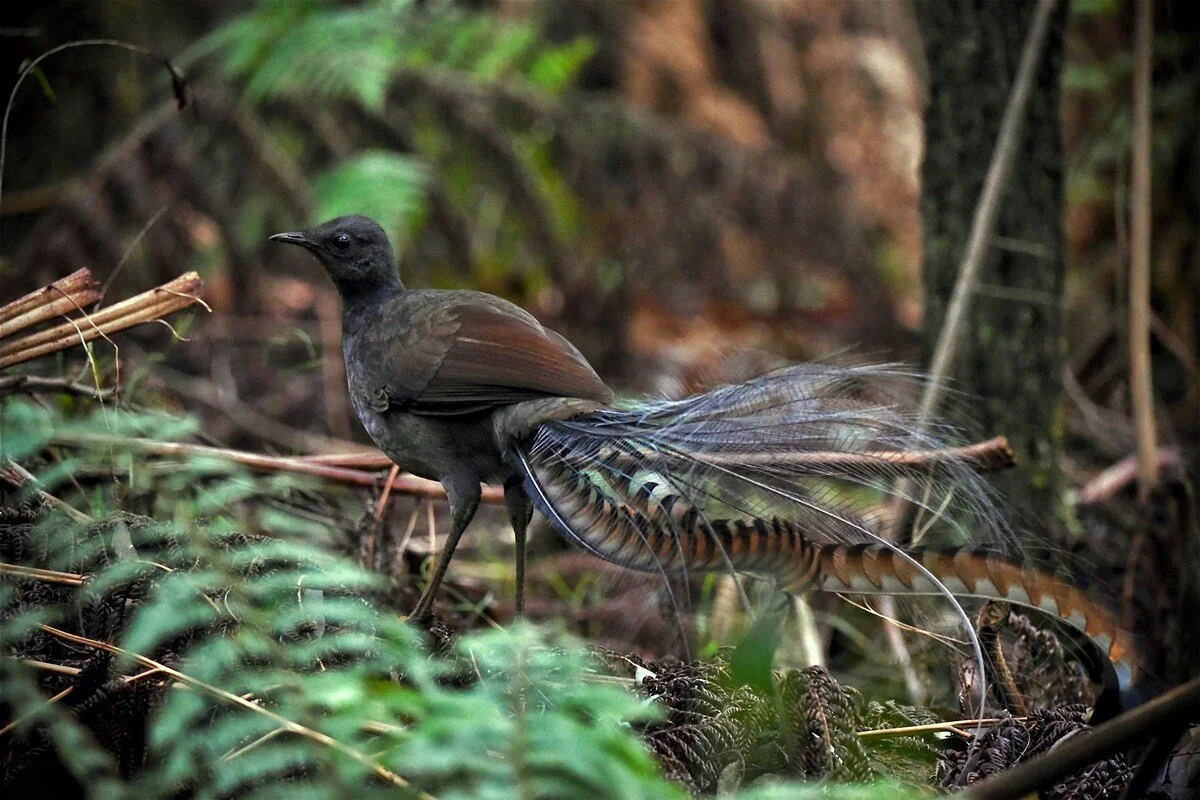
Track 1. Prelude
I hear the lyrebirds
weaving stories through time
with words I have lost.
/
Île Maurice[i]. 1950s. Kung Kung and Popo[ii] flee 梅县区[iii] and dock in Port Louis. Their language is 客家[iv]. They establish Labutik Jaune[v] in Roche Bois, gathering goods from across the island and the world. They gather words, too: French from the bureaus[vi] who embrace their taxes; Creole Morisyen[vii] from the kliyantel[viii] who depend on their sigaret ek lagazet[ix].
/
Constructed amidst the ensemble:
their nest of belonging.
/
Naarm[x]. 1980s. Kung Kung and Popo migrate to Clayton lured by greener horizons.
/
1990s. In the vibrant spaces between school terms, Matt and I sit for days on the thin beige carpet of Kung Kung and Popo’s unit, entertained by screens. Mentholatum floats through the air. American TV shows like Oprah and Jerry Springer weave between ads for Bunnings Warehouse and YoGo Gorilla Mix. Popo turns the soil in the front yard, contained in styrofoam boxes, cultivating cotomili[xi] and chives and potatoes and whatever will grow.
/
Kung Kung doesn’t just watch TV, he collects – phrases scrawled in biros across notebooks. I admire that – his thirst for knowledge within a foreign world – connection through language. He writes – things like Lowest prices are just the beginning between Chinese characters. He synthesises – Australian capitalist culture enters his bloodstream. He collects – fragments compiled like samples of music. He extracts – connective vibrations.
/
How long do these birds
hold deep within their heartbeats
the music of worlds?
Track 2. Shaking tails
His wings, pointed backwards, pulse as if he is moving forwards.
/
1988. Mum’s womb. I twirl as the curls of Creole Morisyen pierce through. I jiggle as 客家 pushes through my soft shell.
/
1990s. Open air. I tango with the institutionalised languages of Australian English emanating from TVs and car radios and kindergarten teachers. My navigation of the world is an interpretive dance.
/
His claws remain in place.
/
Kung Kung and Popo cackle while my toddler body writhes along the carpet, bawling, being way too extra. They record my wails on the stereo, struggling to contain their amusement. Hours later when Mum and Dad come to pick me up, they play the tape. What can be deciphered from that reproduction? The roar of a child, screaming for attention, knowing he is making a fuss, trying to say something.
/
His tail spreads like fanning tiger snakes.
/
Matt and I sit focused on the radio. My finger rests on ‘record’ as we wait for the week’s number one song. I feel it. It’s Barbie Girl by Aqua, it must be. Our ears have been stitched to the countdown all night. The strings come through and my finger responds with the launch of a grand jeté. Finally, a new song for the collection alongside Don’t Speak by No Doubt.
/
He leans forward, reaching upwards in the form of a peacock spider.
/
15 million years ago. A superb lyrebird meets its end and 15 million years later it sits in the archives of the Australian Museum. Not on record: the sounds it collected before our earliest known homo ancestors spoke their first words. How much of their contemporary behaviours resemble their ancestors?
In ideal circumstances, I’d hop in my car to find out, enjoy a drive through winding roads to the Sherbrooke Forest – pack a few picnic items strewn about my apartment for an adventure. But I am lured by the appeal of screens, and I resort to YouTube to study their rituals.
/
Their strands shimmy between slow stretches.
/
Late 1990s. Rafael Nadal applies his signature topspin, and Kung Kung asks me what ‘live’ means, displayed in the corner of his plasma screen TV. He jots it in his notebook. This isn’t the first time he’s asked for a translation, but I feel like I’m drowning. Even in English this word can be confusing. The Macquarie Dictionary offers 47 definitions for ‘live’. How am I to traverse Kung Kung’s limited understanding of Creole Morisyen with my limited understanding of 客家? I try explaining it as a concept, moving with something like: pe arrive astere la mem, to conner? Ici ek laba parrei[xii]. But my dance is too abstract, and soon we return to the quiet comfort of the Australian Open as the sun beams through the living room window.
It’s not until well after he’s gone that I figure it out. En direct, I should have said.
Live.
/
His dance resembles the moves I learn from the Tang dynasty.
/
Sunday mornings. 1990s. Matt and I go to Chinese Mandarin classes at Springvale High School. My parents say it will help us communicate better with Kung Kung and Popo – connect with our ancestry. But Kung Kung and Popo don’t speak Mandarin, they speak 客家, I implore. Take me to 客家 school! Except, there’s no such thing as 客家 school because 客家 is a spoken language, shaped by nomadic peoples. Different versions are cultivated across the planet, much like Creole: always collecting.
I hate it. I hate spending precious weekend hours learning a language of no use to me. Dad says I’m not allowed to use the word hate: you do not hate anything; you simply dislike it.
Turns out, my grandparents speak more Mandarin than I realise. It’s in the newspapers sprawled across the dining table and the SBS Radio blasting from the kitchen. It’s on their passports. Over time, I learn to repeat phrases like a performance, seeking their affection: 你好[xiii], 谢谢[xiv], 看电视[xv]. Kung Kung and Popo say they’re proud of me. I keep dancing.
/
He bobs left then right, his wings fluttering for balance.
/
Dad wants us to participate in as many extracurricular activities as our family can afford. It’s something I can be grateful for only in hindsight. It’s how my brother and I find ourselves in an after-school Chinese dance class, learning movements to folksongs we can’t understand. The lessons are taught by a vibrant woman whose passion for musical performance excites me. But after a handful of traditional performances, I want out. It’s just not very cool. My brother and I set up an offshoot dance club with a few friends. We’re convinced we know what people want.
It begins with a love for Britney Spears and blossoms with a passion for S Club 7. For hours over weekends, we study music videos we record from Video Hits, much in the way I linger over lyrebird choreography on YouTube.
/
His vibrating tail quickens, reaching higher and wider.
Track 3. Fooling experts
Wails of babies
screeching chainsaws
mechanical shutters.
/
In the colder months throughout the Sherbrooke Forest, male lyrebirds as young as six years old sneak down from their bedrooms among the eucalypts and get to work. Using an assortment of collected debris for their materials, they construct stages for the area’s annual music festival. They engineer their environment for personal gain, unconcerned by red tape. Through their efforts, they displace up to 300 tonnes of soil each year, more than any other digging animal.
But this isn’t Meredith: no stories flood Instagram to excite prospective audiences. No posters or signs wrap power poles or traffic lights. No one queues online on Ticketek, spamming refresh. Instead, male lyrebirds perform their latest albums omakase-style, hoping to enrapture roaming females. They compete like humans on episodes of The Voice, offering discerning judges magnificent reconstructions of the sounds they’ve recorded, their male brains like cassette tapes.
I keep thinking about how they’ve traversed this planet for millions of years – before Creole Morisyen or 客家 could be understood. For thousands of generations, they’ve endowed their descendants with their songs. Whose voices did they collect in the Miocene? How close were they to the murmurings of the Thylacoleo[xvi] or the Obdurodon tharalkooschild[xvii] or the Balbaroo fangaroo[xviii]? How much of what we think is the lyrebird’s un-mimicked voice echoes these ghosts? How do we tell, when today, as we infiltrate their habitats and affect their climate, their albums repeat the Anthropocene and the musical scores of their destruction?
/
I look for lyrebirds
speaking in collages
of combined worlds.
/
In high school, I hoard words. I take the ‘blocks’ of the athletics club and the ‘tumble turns’ of the swimming club, the ‘paradiddles’ of my drum classes and the ‘chookas’ of high school musicals.
In Year 10, I learn the art of fitting in when I’m fortunate enough to go on exchange to our brother school, 大商学園高校[xix], in Osaka. I sample the phrases and sounds I’ve gathered from Dragon Ball Z and Naruto. I mix these in with what I’ve learnt and my exchange brother pretends that I’m Japanese. そうですね[xx]!
By Year 12, my Vietnamese and Chinese and Indonesian friends figure out the words that will boost our ENTER (ATAR) scores: ‘ハンバーガー’[xxi], ‘antidifferentiation’, ‘triglycerides’. Our parents make sure we know that if we do not excel in the metrics that can be tested on paper, the shapes of our faces and the curves of our surnames can’t be guaranteed to fill in the remainder.
/
Over time, I develop a neutral accent and no one can decipher my ancestors. When I speak, there is less of where I’ve come from, and more of where I think I’m going.
/
The deeper we push
the more they sound like us
and less like them.
/
My first job out of law school is in the graduate program at the Telecommunications Industry Ombudsman. It’s designed to usher us through the ranks from call centre officers into investigators over 12 months. I take complaints over the phone and record them in the system. When asked, I shorten my surname to Chung to avoid the labour of spelling my full name, which improves my KPIs[xxii]. Often, I’m told I don’t sound like a Chung or that I speak surprisingly well for a Chung. I know what they mean: people with surnames like mine aren’t supposed to sound Australian, we’re supposed to sound like Chungs. Another win for my neutral accent. I wear it like a badge of honour: worth so much more than my bicentennial Australian birth certificate. I succeed in erasing my identity as a Chung and for reasons imposed by the structures that make me, I’m proud to fit in, to be considered one of ‘them’, one of ‘us’ – the lyrebird who sounds like everyone else.
/
Why should it matter:
the curves of my accent
if my surname is Chung?
/
My friend and I ride up a tiny elevator filled with businesspeople in Tokyo’s 浅草[xxiii] district. An American nuclear family gets on from the second floor and a サラリーマン[xxiv] remarks to me in Japanese: ‘Don’t you just hate these Americans and the way they smell?’ I respond with an affectation that veils my identity and I feel the strange gravity of a dysmorphia inherent in fitting in.
/
The train ride from St Petersburg Московский[xxv] to Moscow Ленинградский вокзал[xxvi] takes almost as long as binging The Life of Birds by David Attenborough. Typically, my bladder’s up to the task. But as we pull up to Moscow at midnight, I’m compelled to make a last-minute dash to the toilet. By the time I’m done, my friend has already left the train and I scramble to find her. Once outside the station amidst the darkness, the competition for taxis is ruthless. After some labour of language, we enlist a driver who zips us to our hotel where we will sleep, relax and compile the morning’s itinerary.
But as we arrive at the hotel, I realise I’ve abandoned my Australian passport on the train.
The following days are a strain on my blood vessels and vocal cords. I seek help through every dance I can muster to the Russian police, the Australian Embassy, the Federal Migration Service. There’s only so much I can communicate with the Cyrillic script I learnt on the plane ride from İstanbul and the phrases I’ve collected from acquaintances in St Petersburg. Mimicking the sounds of Привет[xxvii], пожалуйста[xxviii], and спасибо[xxix] gathers only limited sympathy in the city where I’m told that smiling among strangers is taboo.
Unsurprisingly, most can’t believe that I’m Australian. Chinese, surely, they assert, and nothing else. That includes the police officer who’s finally taking my statement after half an hour of my standing in the middle of the station begging the entrance guard for someone who can help me: passport report, пожалуйста, lost passport, пожалуйста, Australian Embassy, пожалуйста, спасибо, PLEASE!
In the comfort of an underground interview room, the officer tells me in English that someone has stolen my passport – right outside this station. I was mugged, he tells me. That is not what’s happened, but I concur. Whatever it takes, I’ll dance. My reality reshapes in front of me. He asks me what I think about Russian women. Before I can answer, he tells me that it’s true: they’re beautiful. He asks me how many kangaroos I own. He doesn’t ask me about lyrebirds. I tell him I’m flying to Israel in two days. I tell him: yes, I do love kangaroos and Russian women – anything for him to write to the Australian Embassy and help me with obtaining the emergency passport I need to leave the world’s largest country.
/
From the comfort of my balcony
I hear the tunes of magpies and wonder
if it matters if they are lyrebirds instead.
Track 4. COVID-19 retrospective interlude
☕🥐🤸🌿🦩
🌞 👨💻😷🛹🎨🎹✍
🧘🚿🧖🥃🌝
Track 5. Listening closely
Male lyrebirds are known to sing, but it’s from the females that I learn the value of listening, begin to mourn the spaces where I no longer belong. I don’t know who currently lives in my grandparents’ unit in Clayton, but realestate.com.au reveals it’s succumbed to renovations beyond recognition.
/
Late 1990s. Same place. My brother and I assume our spots on the couch while Mrs Doubtfire plays on one screen and Mr Bean on the other. Mum and dad converse with Kung Kung and Popo in a melange of languages, from politics and recipes to how absurdly funny it is when Robin Williams slams his face into a cake, the cream inevitably dripping into cups of tea.
Occasionally, my parents joke about us in 客家 within earshot, alluding to our limited understanding of the language. Ta m sit[xxx]? They ask. Ta m sit, I respond, my eyes fixed on Rowan Atkinson smooshing a lump of steak tartare under a side plate.
/
2021. I learn from my theatre residency with Merlynn Tong that eavesdropping can be the catalyst for a bloody good piece of dialogue. Admittedly, it’s not my normal mode of being. Often, I’m more concerned with the discourse in my head. Nevertheless, I come to learn a few things. I learn that in the long walks around my neighbourhood, there’s a difference between the voices of stocky magpies and nimble magpie-larks. I learn that I need not rely on the ‘Birds of the Forest’ playlist on Spotify; beautiful songs fill my St Kilda block, voiced by red wattlebirds and common mynas and superb fairywrens.
/
2015. I realise the אל על [xxxi] staff at Moscow Шереметьево[xxxii] International Airport aren’t too fond of travellers with emergency passports, especially ones printed in an office in Moscow. I show them the letter from the police, written in Russian I can’t read. They place a mark on my emergency passport. They ask me what happened to my original passport, why I’m visiting Israel, who I’m visiting, whether I’m truly Australian.
/
In my attempt to leave Tel Aviv, airport security staff at בן-גוריון [xxxiii] direct me to a room while those with ‘regular’ passports stroll leisurely through the gates. They ask me to take off my shoes, my pants, my shirt. They ask me what I’ve done in Israel, who I’ve visited, whether I’m truly Australian.
/
There are lessons in what cannot be heard. I read that the numbers of the regent honeyeater are so diminished that they may soon forget the voices of their kin – they will forget their song, linger into extinction through silence. I learn that it’s been over five years since I’ve heard Kung Kung speak to me in 客家 – since I’ve heard anyone in my family speak it, heard anyone.
/
Early 1990s. Popo leads the way past the kindergarten, around the corner, and left into Coles. World 4 Kids beckons from the far side of the parking lot. We seldom talk on these walks. If there is any exchange, it is her yelling at me to keep up. The way I laugh resembles hers.
Popo attempts to pay the cashier for groceries but the mood is burnt orange and I feel anger and frustration that isn’t mine slowly invading my body. She doesn’t understand the correct total. She asks the cashier in 客家 and looks to me for answers. All I can remember is feeling embarrassed for her inability to communicate in the language expected of us – in this moment, we are entangled. I wish I’d listened more closely to what had happened that day, but the specifics are muffled, like water in my ears. Oh, Popo. I miss you so much. Mo mank twa. Ki to pe fer zordi[xxxiv]? I wish I could still hear your voice and your words and your dance.
/
The yodel of the magpie is truly beautiful
its voice spins like an imperial hairstreak butterfly
the lyrebird replicates it with ease.
Track 6. Fading away
I hear the lyrebirds
weaving stories through time
with words I have lost.
/
2023. A Mauritian friend from high school pops up in the Port Phillip City Council newsletter. It’s been decades since we shared words, so I send him a message. We get to talking about Creole Morisyen, our love for lamisik Séga[xxxv], our cravings for dalpuri and napolitain cakes. I share my hopes to raise awareness about our language among Australians. Our conversation starts in Creole Morisyen, but the words are laboured like stuttering dance moves – and we’re back to English, sprinkled with rehearsed phrases. Dan bez, ein[xxxvi]?
/
Why should it matter
the curves of my accent
if my surname is Chung?
/
2019–20. Bushfires engulf the east coast of Australia. Over one billion animals succumb to the heat, losing their bodies and voices. More than half of known lyrebird habitats are scorched. As we continue to play with our planet’s climate, emerging bushfires will ravage their homes, their culture, and their languages. We’ll lose habitats faster than we can count – and we’ll have little to blame other than how little we tried. Soon, there’ll be nothing left to record.
Lyrebirds don’t have written language. Their words are as ephemeral as the Creole Morisyen and 客家 of my ancestors. The sounds they’ve collected over millions of years linger as ghosts we cannot readily decipher. Our continued neglect towards them threatens to ensure they never hear the future. I want to go to the Sherbrooke Forest, to the valleys of the Dandenong Ranges and record them all, the way Matt and I collected our favourites from the radio on cassette tapes.
/
15 million years ago
a lyrebird dies
leaving a silent fossil
sitting in a museum.
/
I wish Kung Kung is here with me in this apartment he has never seen. I want to tell him what ‘live’ means. I want to speak with him about his collected works: the ones that persist as fragments in yellowed notebooks, resting among the hoarded artefacts throughout my parents’ garage. I want to hear Creole Morisyen and 客家 from his lips. I want to ask him why he writes so much of what he hears. Then I realise that he and I are the same: we are writers, writing to make sense of it all.
/
After Chinese school
my Mandarin fades
into words I rehearse
for their attention.
/
On 31 March 2021, Apa, my maternal grandfather, passes away in the home he built in Beau Bassin, Mauritius. He is our last family member whose first language is 客家. There are no more preset opportunities for me to hear this language – only forced attempts and fading memories.
Track 7. Outro
I hear the lyrebirds
weaving stories through time
with words I have lost.
/
I look for lyrebirds
speaking in collages
of combined worlds.
/
I hear the dear lyrebirds
their voices clear
our fates entwined. ▼
—————————————————
[i] French: Mauritius.
[ii] Chinese Hakka: Grandpa and Grandma on my father’s side.
[iii] Chinese Mandarin: Meixian District, China.
[iv] Hakka.
[v] Mauritian Creole: The Yellow Corner Store.
[vi] French: offices.
[vii] Mauritian Creole.
[viii] Mauritian Creole: clients.
[ix] Mauritian Creole: cigarette(s) and newspaper(s).
[x] Woi Wurrung: Melbourne, Australia.
[xi] Mauritian Creole: coriander.
[xii] It’s happening now, you know? Here and there the same.
[xiii] Chinese Mandarin: nǐ hǎo, hello.
[xiv] Chinese Mandarin: xièxiè, thank you.
[xv] Chinese Mandarin: kàn diànshì, watch television.
[xvi] Marsupial lion.
[xvii] Giant platypus.
[xviii] Fanged kangaroo.
[xix] Daisho Gakuen High School.
[xx] Japanese: soudesune, indeed!
[xxi] Japanese: hanbaagaa, hamburger.
[xxii] Corporate: Key Performance Indicators.
[xxiii] Japanese: Asakusa.
[xxiv] Japanese: sarareeman, salary man.
[xxv] Russian: Moskovsky.
[xxvi] Russian: Leningradsky vokzal, Leningradsky Station.
[xxvii] Russian: privet, hello.
[xxviii] Russian: pozhaluysta, please.
[xxix] Russian: spasibo, thank you.
[xxx] Hakka: do you understand?
[xxxi] Hebrew: El Al, skywards.
[xxxii] Russian: Sheremetyevo.
[xxxiii] Hebrew: Ben-Gurion.
[xxxiv] Mauritian Creole: I miss you. What are you doing today?
[xxxv] Mauritian Creole: Séga music.
[xxxvi] Mauritian Creole: A problem, isn’t it?
Image: Geoffrey Moore - Unsplash
If you liked this piece, please share it. And please consider donating or subscribing so that we can keep supporting writers and artists.