
Six-and-a-half meditations on life in the nether regions – by Danielle Wood
ISLAND | ONLINE ONLY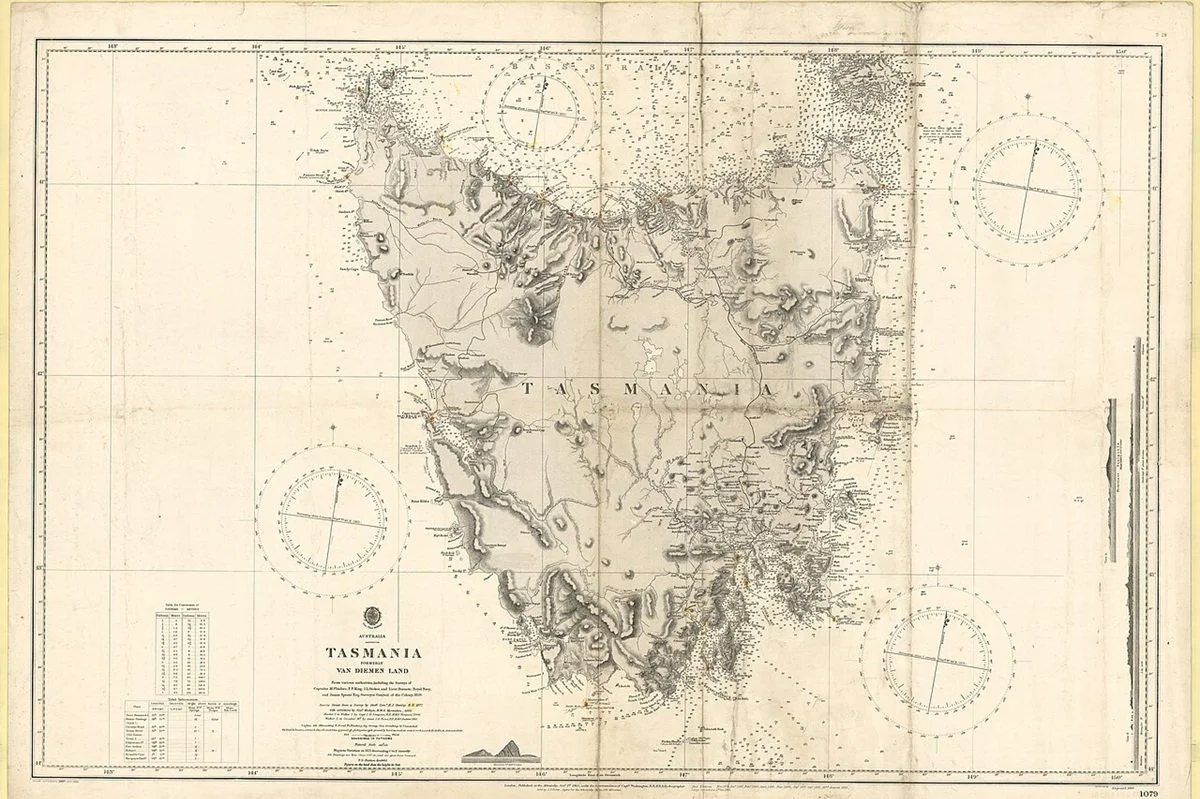
At the Island Readers & Writers Festival in 2026, three writers were asked to present a piece inspired by the phrase, ‘the ends of the Earth’. Designed to be spoken and heard, the poetic essay ‘Six-and-a-half meditations…’ works wonderfully as a listening experience, as you’ll discover if you click below. but if you would prefer, you can read the text.
Part one: A special kind of nowhere
After Carmel Bird
In the mid-19th century, a Lady Blessington invited the Danish writer of fairy tales, Hans Christian Andersen, to her famous London salon. And there on her Kensington balcony – so richly covered with vines – what exotic thing did she invite him to caress? Why, she told him, it was a blackbird from Van Diemen’s Land.
In 1930, when his play Private Lives debuted in Edinburgh, playwright Noel Coward cast himself in the role of Elyot Chase. And so it was he uttered the line – with his mouth full, according to the stage direction: – ‘I once had an aunt who went to Tasmania’.
In 1941 Virginia Woolf’s novel Between the acts arrived on the bookshelves of the world. And pressed into its pages was the flirtatious Mrs Manresa, so described: ‘She was born, but it was only gossip said so, in Tasmania: her grandfather had been exported for some hanky-panky mid-Victorian scandal.’
Here in the 21st century, the Earth now shrunk to a pip inside its world-wide web, we might have believed our island to have solidified out of the myth. But only as long ago as Hollywood, 2012, Pitch perfect brought us Fat Amy, who stepped up to the Bellas and said: ‘I’m the best singer in Tasmania … with teeth’.
Part two: Etymology
Here in the nether regions we’re a linguistic world away from the Netherlands
named in the days when ‘nether’ – tossing innocently about in the word salads of Europe – meant only lower, or under, or down.
It was English that changed ‘nether’, giving it a half-turn towards meaning ‘inferior’, before cranking it the entire way to ‘hell’.
Then some obedient Victorians, eyes front, succeeded where Orpheus failed. But although they retrieved ‘nether’ from the underworld, it was, from then on, a shade. A mere sniff of brimstone in its vapours, it drifted through stuffy parlours: a ghostly little euphemism collecting smut on its thin, lacy shift.
Part three: Shape
Here’s another word: pareidolia. It’s the one for when you see an anxious little face in your power point, or Jesus spread out on your toast.
Canada, 1954: a mass pareidolia event. The $1 note is withdrawn from circulation, and all because the curls near the ear of an unwrinkled Queen Bess seem to swirl into the face of a devil.
Our island’s triangular. Equilateral, near enough, with a netherwards tip, and a little dip in the northernmost coastline. Do you see a heart? A shield? A North Hobart demon with a trim John Dee beard? No. We’ve been schooled in what it looks like. We’ve seen the underpants, the aprons, the shirts.
Picture if you will Sir Les Patterson. Are you seeing him? The monstrous teeth? The contorting lips? The half-closed eyes? The beery leer? He wasn’t the one to coin the phrase in question, but he certainly helped take to the world. Here he is, in 1982, Australia’s cultural attaché to the Court of St James, fully manspread in his chair, telling Michael Parkinson about taking a young sheila for a taxi tour of London’s sites. The tour comes to an end; the cabbie taps the meter. In the back seat, the sheila drops her daks, and pays their way with her Map of Tasmania.
Part four: 152 vulvas, hanging on the wall
So there I am out in Berriedale on Level B2 of David’s palace looking at Greg Taylor’s labour of labia. There’s the shaggy and the clipped, the protuberant and withdrawn, the symmetrical and the skewed. I’m wondering how the gift shop people chose which five of them to turn into soaps. They picked out Bianca, Veronique, Shanti, Lizzy, and Cath. I’m wondering how many Biancas and Veroniques, how many Shantis and Lizzys and Caths have been sudsed down to nothing in the shower, and how many others are living out their Venuisan lives on a vanity, as an untouched trophy on a scallop shell dish?
A school group troops into my reverie. I almost – almost – leave
But then I notice they’re boys, all boys. With clipboards. Their blazers’ trim is bright as their cheeks in the gallery’s dim.
Dare ya, says one
The other says, nah
Haven’t you got the balls? says one
Says the other, like you have
I’ll do it if you will, says one
Then after a long minute, the other says … orright
So that’s that, then. They’ve agreed. Shoulder to shoulder, at first, then diverging, they stroll wallwards, hands in pockets, pulse in throats. The gallery attendant’s not watching, but God knows I am, and I really think they’re going to do it.
The scuffed toe of one black leather shoe edges … just … over the line on the floor. Then retreats. They’re not going to do it after all. Something has stopped them and I think it’s the cross-armed silhouette of their teacher and his fine act of youngish masculine chill. The pair turn and retreat, boyish tongues untouched by the porcelain still.
Four-and-a-half: From A feminist cartography by Odelia Dowlen
‘It’s hard to deny,’ writes Dowlen, ‘that the shape of the island is suggestive.’
Part five: How to fuck an island
Well, shall we count the ways?
In roughly chronological order
you can do it with a flagpole
you can do it with a musket
you can do it with a bounty
you can do it with some snares
you can do it with a chainsaw
you can do it with a log truck
you can do it with a turbine
you can do it with a dam
you can do it with gay prejudice
you can do it with 1080
you can do it with a pulp mill
you can do it with a bribe
you can do it with a big, burst sav
you can do it with incompetence
you can do it with the pokies
you can do it with some fish
and since we never learn
we’ll one day not too far
do it all again, but with a cable car
Part six: Limericks
One morning I woke up and realised that every limerick I knew off by heart was kind of rapey. Not even kind of. They were just rapey. How had I missed that? How had the cleverness of rhyming ‘girl from Aberystwyth’, and ‘the parts that they pissed with’, occluded the glaring fact that the miller’s son, Jack, had knocked our heroine flat on her back? And how had the seductive metre, when Titian’s model for Rose Madder reclined on her ladder, drawn my attention so far away from the fact that the painter didn’t ask before he climbed up that ladder and had her? Clearly, this was a situation that required remedy.
Then I got to wondering …
Could a limerick conclude this strange mix,
Of word play and crassness and tricks?
Could it express, without guile,
What I wish for this isle?
Which is a lot more respect; fewer dicks.
▼
Image: United Kingdom Hydrographic Office
If you liked this piece, please share it. And please consider donating or subscribing so that we can keep supporting writers and artists.