
To let my outline thin – by Bridget Webster
ISLAND | ONLINE ONLY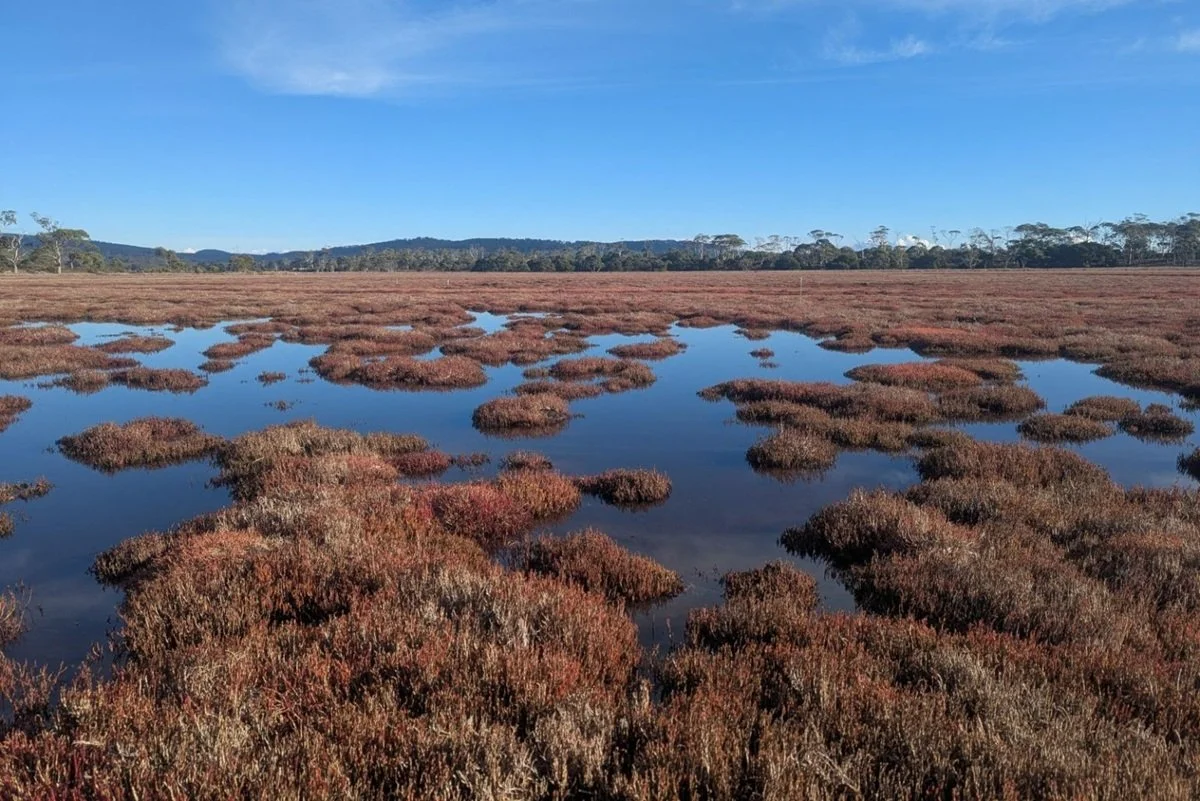
Being awarded the inaugural Nature Writing Prize for a story that I was sure was somehow too odd, too maximalist, too close to poetry for the hallowed halls of literature has been a profound experience. I am still chuffed that the perspective of a decomposing corpse being absorbed by a forest is one that others found as interesting as I do, and that my interpretation of this process resonated. Since winning, I have found myself more attuned to my inklings, my creativity galvanised. I am more committed to experimentation in my work, and to the complexity that deep intellectual and artistic engagement with nature – reality, life, the world, etc – demands.
The generous accoutrements of the prize – namely, money that enabled me to travel to Lutruwita, a weeklong residency, a package of Tasmanian books and participation on a Nature Writing panel at Fuller’s Bookshop – were life-altering gifts. I am grateful beyond language to have been given them. Excitingly, the panel event left me with more questions than answers about how art and nature intersect. It was a joy to hear the incredible audience’s and other panellist’s perspectives, and to be able to share mine. So much of what you put into a story becomes sort of submarine, and the act of publishing can feel lonely – a one-way conversation, a missive into the void. The panel event was a rich antidote to that loneliness, and for an emerging writer, incredibly affirming for my practice and ambitions. I also left with several on-point book recommendations – always a salivatory party favour to receive.
The residency week that I spent at the Tasmanian Land Conservancy’s beautiful Sloping Main Reserve on Turrakana/Tasman Peninsula was, to be perfectly frank, mindboggling. The reserve protects a nationally significant saltmarsh community, a ruddy vista of plush glasswort tussocks fringed by threatened white gum coastal forest. Dormant intertidal waterways thread the marsh, their undulating beds draped gothically with some kind of bleached vegetal mat. Here and there the mud is stamped crisply with the familiar symmetric iconography of wallaby tracks. Over the gentle dunes lies one of the most stunning and humanless beaches I’ve ever seen – fine, glittering sand curving riblike toward a horizon busy with landmass, Kunanyi winking across the waves. Two hooded plover pairs live here, scoot ceaselessly across the sand. They always appear to me somehow beleaguered, bundled, hunching their shoulders against the wind.
This was my first writing residency. A lot of interesting things happened. At night, my animal neighbours would skitter and thump around the old farmhouse in an abundance I have scarcely borne witness to in my short(ish) urban(ish) existence. I felt the range of my emotions widen – the grief and terror deeper than I let myself feel in the city before scrambling for distraction, the bliss and contentment more whole and suffusing. I felt my attention span extend, too, like a drought-struck snail emerging from its shell, smelling the coming ablutions of rain. Without other people, without service, my thoughts were in constant conversation with the life around me. The umwelts of the fauna, diversity of the flora, and all the people that have cared for, loved, altered and lived alongside that stunning place, stretching back through the ages. To be alone, alone, to let my outline thin; to lie on the saltmarsh amid nocturnes of nibbling as the stars and their crepuscular companions emerge! I felt to be somehow in more vivid communion with reality, like I was emerging from a fugue state.
Each day I spent a few hours writing, an absolute gift. Most of my time, though, was spent outside. Exploring, swimming, sitting and watching, trying to soak up as much experience in as subtle detail as possible. I framed my job for the week as simply noticing and feeling, an incredibly liberating task. I often thought of myself as a wire, growing ever finer, more conductive.
On the second day, raw with reverence, I dissolved into tears, feeling that I did not, could not deserve such a rich experience. Mid-sob, however, something in me retorted No, actually. Everybody deserves this kind of experience. Every single person. Including you. Communion with nature is one of our base human rights, and it’s an abiding tragedy that this has become too often and for too many people a luxury. This reframing, of course, made me sob harder, but in a much less gratuitously guilty sort of way. Following this, I cried every day – on my knees at the mouth of the weir, letting my mind leak into a bird, washing a hundred honeyed ants down the drain. When I find the wing feather that I watched detach and fall from a white-bellied sea eagle arcing through the blue. I’m not a massive crier, usually. But something had cracked open.
Nature – reality, life, the world, etc – is our greatest teacher. All culture flows from the land. The polycrisis we face is cultural as much as it is material – perhaps even more so, considering we already have all the solutions we need (including analysis that shows the entire global population could enjoy decent living standards for only 30% of current resource and energy use[1]). The culture I have inherited, as a white person in a settler-state, is the culture of imperialism, extractivism, colonialism. It stems from an impoverished relationship to land: a relationship become rapacious and dominating, made possible by disconnection from place as well as transplantable technologies. A culture that shapes wherever it lands, rather than is shaped by the land where it is. When I write about nature, it is imperative that I work to change my culture’s relationship to land, and my own. I can think and read as much about this as I like. But one of the pitfalls of colonial epistemics, alongside worship of the written word (guilty, working on it) is believing that one can know about something without having experienced it – or, to be more specific, without practicing it. I genuinely have not before had access to the kind of experience of nature that this prize afforded me. I also didn’t know that I needed it. Periods of solitude in nature are a component of many land-based cultures’ spiritual practices. What humans (as incorrigibly social beasts) quickly experience is that this solitude transforms into a visceral sense of being in communion, in community, with the more-than-human world. With our kin. I felt what I’m sure was a whisper, a skerrick, a morsel of the porousness and relationality that this practice brings, and I am changed. I can feel that my writing will change, too.
I believe this prize is stewarded by people who are also committed to renewing and revolutionising our relationship with the world – those at Island magazine, at the Tasmanian Land Conservancy, and at Fuller’s Bookshop. I’m bloody excited to read the work of future shortlistees and winners of this prize, to meet comrades in ideas and aspirations, writers who understand the complexity and responsibility of making art in conversation with the concept of nature. I know the experience will commit them more deeply and inextricably to the change we must create, as it has committed me. ▼
Bridget Webster won the inaugural Island Nature Writing Prize with her story, ‘Like all good fruit’. You can read it in Island 176. The runners up were Habitat, by Rosalee Kiely, and Menura novaehollandiae, by Frankey Chung-Kok-Lun
[1] https://www.sciencedirect.com/science/article/pii/S2452292924000493
Image: Tasmanian Land Conservancy
If you liked this piece, please share it. And please consider donating or subscribing so that we can keep supporting writers and artists.